
Technical Engineering Hub
Industrial Insights, Products & Supplier Guides by Shri Ganesh Sales
Explore industrial supplier insights, product guides, and location-based solutions across Kota, Jaipur, and Rajasthan
Explore industrial supplier insights, product guides, and location-based solutions across Kota, Jaipur, and Rajasthan
Published: May 3, 2026
In chemical storage tanks handling acids, alkalis, and aggressive solutions, selecting the wrong resin grade can lead to early-stage surface degradation, micro-cracking, and eventual leakage. This is not a theoretical risk—many factories in Jaipur’s chemical and water treatment sectors face tank failures within 6–12 months due to incorrect resin selection, especially under continuous exposure to corrosive media and temperature variations.
When searching for the best unsaturated polyester resin for chemical tanks in Jaipur, the focus should not just be on availability, but on long-term corrosion resistance and compatibility with stored chemicals. In FRP tanks used for acid storage or effluent treatment, resin performance directly impacts structural integrity and maintenance frequency. A poor choice often results in costly downtime, re-lining, or complete tank replacement.
Jaipur’s growing industrial base—ranging from plating units to water treatment plants—demands resin grades that can withstand both chemical attack and operational stress. This makes resin selection a critical procurement decision rather than a routine purchase.
If you're sourcing resin in Jaipur, choosing the right grade is critical to avoid premature failure and operational losses.
In chemical storage environments, selecting the right unsaturated polyester resin for chemical tanks is directly linked to structural integrity and long-term resistance against aggressive media. UPR resin is a thermosetting polymer formed by reacting unsaturated acids with glycols, which then cross-links with styrene to create a rigid, chemically stable matrix.
In FRP tank manufacturing, this resin acts as the binding phase that holds glass fibers together, creating a composite structure capable of handling corrosive chemicals, temperature variation, and mechanical stress. The performance of the entire tank depends heavily on how well this resin resists chemical attack at the molecular level.
In real industrial scenarios—such as acid storage in plating units or chemical dosing tanks in water treatment plants—poor resin selection leads to early signs of failure like surface blistering, micro-cracks, or chemical permeation. Once this starts, repair is costly and often requires full tank replacement, causing operational downtime.
The reason UPR-based FRP resin is widely used is its balance between cost, processability, and chemical resistance. It offers good resistance to diluted acids, salts, and industrial chemicals when properly selected and cured. However, its effectiveness depends on formulation, curing system, and compatibility with the stored chemical.
For industrial buyers in Jaipur and across Rajasthan, understanding this base behavior of UPR resin helps avoid premature tank degradation—especially in applications where continuous chemical exposure is unavoidable.
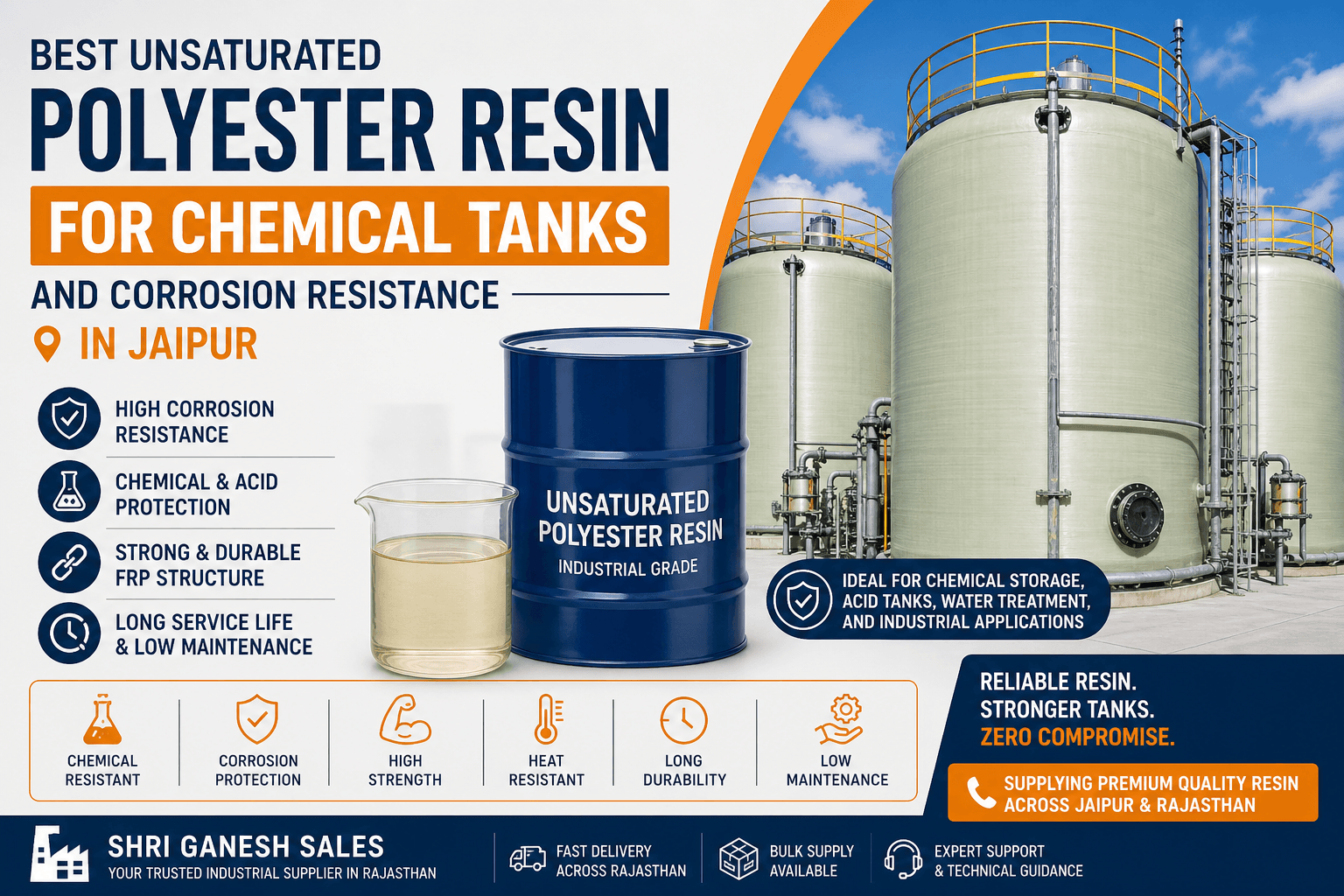
When comparing orthophthalic vs isophthalic resin, the difference becomes critical in chemical tank environments where exposure to acids, alkalis, or solvents is continuous.
Orthophthalic (Ortho) resin is cost-effective and commonly used for general-purpose FRP applications. However, in chemical storage tanks, it tends to show early signs of degradation—surface cracking, osmotic blistering, and reduced structural integrity—especially when exposed to aggressive chemicals like hydrochloric acid or caustic solutions. This makes it a risky choice for long-term industrial use.
Isophthalic ISO resin, on the other hand, is specifically engineered for higher chemical resistance and durability. In real plant conditions—such as acid storage tanks in chemical processing units—it performs significantly better by resisting hydrolysis and maintaining mechanical strength over time. Iso resin also offers better temperature tolerance, which is crucial in processes where chemical reactions generate heat.
For even harsher environments, vinyl ester resin sits above both. It provides superior corrosion resistance and is often used in critical zones like tank linings or areas with high chemical concentration. However, it comes at a higher cost, so it’s typically used selectively rather than for entire tank construction.
In practical terms:
Choosing between these isn’t just about material cost—it directly impacts maintenance cycles, leakage risk, and downtime in industrial setups across Jaipur and Rajasthan.
A careful evaluation of chemical exposure and operating conditions helps avoid premature tank failure and costly replacements.
In industrial environments, resin failure in chemical tanks is not gradual—it’s often sudden, expensive, and operationally disruptive. The first visible sign is usually surface blistering or micro-cracks inside the tank lining. In acid storage applications, especially with HCl or sulphuric acid, incorrect resin selection leads to rapid chemical attack, causing softening and eventual structural breakdown.
Once corrosion penetrates the laminate, leakage begins. Even minor seepage can contaminate surrounding areas, damage civil structures, and trigger safety hazards. In several Rajasthan-based plating units, tanks built with low-grade polyester resin have failed within 6–12 months, forcing complete shutdowns for relining.
The bigger risk is structural failure. When the resin loses its chemical resistance, the FRP matrix weakens, reducing load-bearing capacity. This can result in tank bulging or catastrophic rupture under pressure—particularly in elevated storage systems.
Downtime cost is where the real impact hits. A single tank failure can halt production lines for days, disrupt supply commitments, and lead to emergency procurement at higher costs. Maintenance teams then face repeated repair cycles instead of long-term reliability.
From a supplier’s perspective, consistent failures are almost always traced back to wrong resin grade selection—not fabrication defects. For industrial buyers in Jaipur, working with experienced suppliers like Shri Ganesh Sales helps prevent such risks by ensuring the right corrosion-resistant material is sourced for specific chemical environments.
A wrong resin choice can shut down your plant within days.
In chemical processing environments, selecting the right FRP resin for chemical tanks directly impacts service life and safety. Different applications demand different resin behavior under continuous chemical exposure.
In acid storage tanks—handling substances like hydrochloric acid, sulfuric acid, or nitric acid—the resin must resist surface erosion and prevent micro-cracking. In multiple industrial cases across Rajasthan, tanks built with improper tank resin grades showed inner layer degradation within 6–12 months, leading to leakage risks and unplanned shutdowns.
For alkaline chemical storage, such as caustic soda or ammonia-based solutions, the resin must maintain structural integrity under high pH conditions. Here, acid tank resin selection alone is not sufficient—compatibility with alkaline environments becomes equally critical to avoid brittleness or softening over time.
In water treatment plants, especially in Jaipur’s industrial zones, tanks are exposed to a mix of chemicals—chlorine, coagulants, and varying pH levels. This requires FRP resin systems that can handle fluctuating chemical loads without compromising laminate strength. Poor resin selection in such applications often leads to delamination, increasing maintenance frequency.
From a supplier perspective, the application defines the resin choice—not just availability. This is particularly important when resin is used alongside FRP lining systems, where long-term corrosion resistance determines operational reliability.
When evaluating FRP tank resin specification, the focus must be on measurable performance parameters rather than generic resin grade claims. In chemical tanks handling acids, alkalis, or oxidizing agents, three properties directly determine service life: thermal stability, chemical resistance, and mechanical integrity.
Heat resistance is critical where stored chemicals generate exothermic reactions or are maintained at elevated temperatures. Standard polyester resins begin softening beyond 60–70°C, but higher-grade formulations (like isophthalic-based systems) can withstand continuous exposure up to ~100°C. In water treatment plants across Jaipur, tanks exposed to fluctuating temperatures often fail prematurely when this limit is ignored.
Chemical compatibility must be validated against the exact media concentration. For example, hydrochloric acid or caustic soda can cause gradual resin matrix breakdown if the crosslink density is insufficient. A properly specified corrosion resistant polyester resin will have documented resistance charts indicating weight loss %, surface degradation, and exposure limits. In real industrial scenarios, mismatched compatibility leads to micro-cracks, which eventually escalate into leakage and shutdowns.
Mechanical strength ensures the tank handles internal pressure, load stress, and long-term fatigue. Parameters like tensile strength (typically 60–90 MPa for high-grade resin systems) and flexural modulus determine resistance to deformation. In FRP tank manufacturing units, inadequate strength often results in bulging or structural distortion within a year of operation.
From a supplier standpoint, consistent batch quality and proper curing characteristics are equally important. Even a high-grade resin can fail if viscosity, gel time, or catalyst compatibility varies between batches—something frequently observed in unverified supply chains in Rajasthan.
For industrial buyers, validating these specifications before procurement is not optional—it directly impacts maintenance cycles, safety, and operational downtime.
Selecting the right material is not just about compatibility—it directly impacts tank lifespan, safety, and maintenance cost. When evaluating how to choose resin for chemical tank, industrial buyers need to focus on three critical parameters:
Different chemicals attack resin structures differently. For example, strong acids like HCl or H₂SO₄ can rapidly degrade standard grades, while alkaline solutions require better hydrolysis resistance. In FRP tanks used in plating or water treatment plants, mismatched resin leads to inner surface erosion and eventual leakage within 6–12 months.
Temperature accelerates chemical reactions. A resin that performs well at ambient conditions may fail under elevated temperatures (60–80°C). In real plant conditions, tanks storing hot process chemicals often show blistering or cracking when the resin is not temperature-rated.
Short-term cost saving often results in long-term failure. If the tank is expected to run for 5–10 years without major shutdowns, selecting a higher-grade corrosion-resistant resin becomes essential. Frequent repairs not only increase cost but also lead to production downtime—especially critical in continuous process industries.
From a supplier standpoint, many failures in Rajasthan industries happen due to selecting resin based only on price rather than application data. This is where experienced sourcing support becomes important. For industrial buyers in Jaipur, working with suppliers like Shri Ganesh Sales helps ensure the resin is matched to actual chemical conditions, not just specifications on paper.
Before finalizing your material, discuss your tank application in detail—chemical composition, temperature, and usage cycle—with an expert to avoid costly failures.
For industrial buyers handling chemical storage or FRP tank manufacturing, working with a polyester resin supplier in Jaipur is not just a convenience—it directly impacts project timelines, material reliability, and operational risk.
In real plant conditions, delays in resin availability can halt fabrication or repair work. For example, during tank relining or emergency leakage repair, even a 24–48 hour delay in resin procurement can escalate into production downtime, chemical exposure risks, and costly shutdowns. Local suppliers eliminate this gap by ensuring faster dispatch and immediate availability of standard and specialty grades.
Another critical factor is technical support at the time of selection. Resin performance in chemical tanks depends on correct grade matching with stored chemicals. Local suppliers in Jaipur who regularly deal with FRP fabricators and chemical industries understand these compatibility requirements. This reduces the chances of incorrect resin selection—one of the most common causes of premature tank failure.
Logistics also play a major role in bulk procurement. Transporting drums of resin from distant locations increases:
A Jaipur-based supply partner ensures predictable delivery cycles, especially for ongoing industrial consumption.
For factories in Rajasthan, working with experienced suppliers like Shri Ganesh Sales helps maintain continuity in operations. Their sourcing network and bulk handling capability allow industries to procure required resin grades without long waiting periods, even for urgent requirements.
When dealing with corrosion-sensitive applications, supplier reliability is directly linked to plant safety. Choosing a local supplier reduces uncertainty across procurement, technical validation, and delivery—making it a practical decision rather than just a logistical one.
Get bulk pricing and fast delivery across Jaipur to avoid procurement delays in critical operations.
Selecting the right industrial polyester resin Jaipur is not just a material decision—it directly impacts tank life, plant safety, and long-term operational cost. In chemical storage environments, even a small mismatch in resin grade can lead to surface degradation, leakage, and unplanned shutdowns.
For industrial buyers, the focus should always be on correct resin selection + reliable supplier support. Local availability, technical guidance, and consistent supply play a critical role in avoiding downtime, especially in ongoing production setups or urgent maintenance scenarios.
Working with experienced suppliers like Shri Ganesh Sales ensures that you not only get access to the right resin grades but also reduce procurement delays that can impact your operations.
If your application involves acid storage, water treatment, or FRP tank manufacturing, choosing a dependable supply partner in Jaipur, Rajasthan becomes a practical necessity—not an option.
👉 Contact Shri Ganesh Sales today for bulk supply and fast delivery in Jaipur.