
Technical Engineering Hub
Industrial Insights, Products & Supplier Guides by Shri Ganesh Sales
Explore industrial supplier insights, product guides, and location-based solutions across Kota, Jaipur, and Rajasthan
Explore industrial supplier insights, product guides, and location-based solutions across Kota, Jaipur, and Rajasthan
Published: September 8, 2026
Acid proof lining is a chemical-resistant barrier applied to tanks, floors, trenches and vessels to stop acids and effluent attacking the steel or concrete underneath. It is delivered three ways: FRP laminate, acid-resistant brick or tile over a membrane, or a coating system. In Rajasthan in 2026, installed cost runs roughly ₹40 to ₹350 per square foot for FRP systems and ₹450 to ₹900 for brick lining, driven mainly by resin grade, laminate thickness and how much surface preparation the substrate needs.
Most acid proof lining jobs that fail do not fail because of bad workmanship. They fail because the wrong resin was quoted against the wrong chemical, and nobody caught it until the tank was already blistering.
We have been lining tanks, floors, trenches and vessels for plants around Kota for over 25 years. This guide covers what acid proof lining actually is, how the job is done properly, how to pick the right system for your chemistry, and what it realistically costs per square foot in Rajasthan in 2026. It is written for plant and maintenance engineers who have to specify the work and then defend the number to a purchase committee.
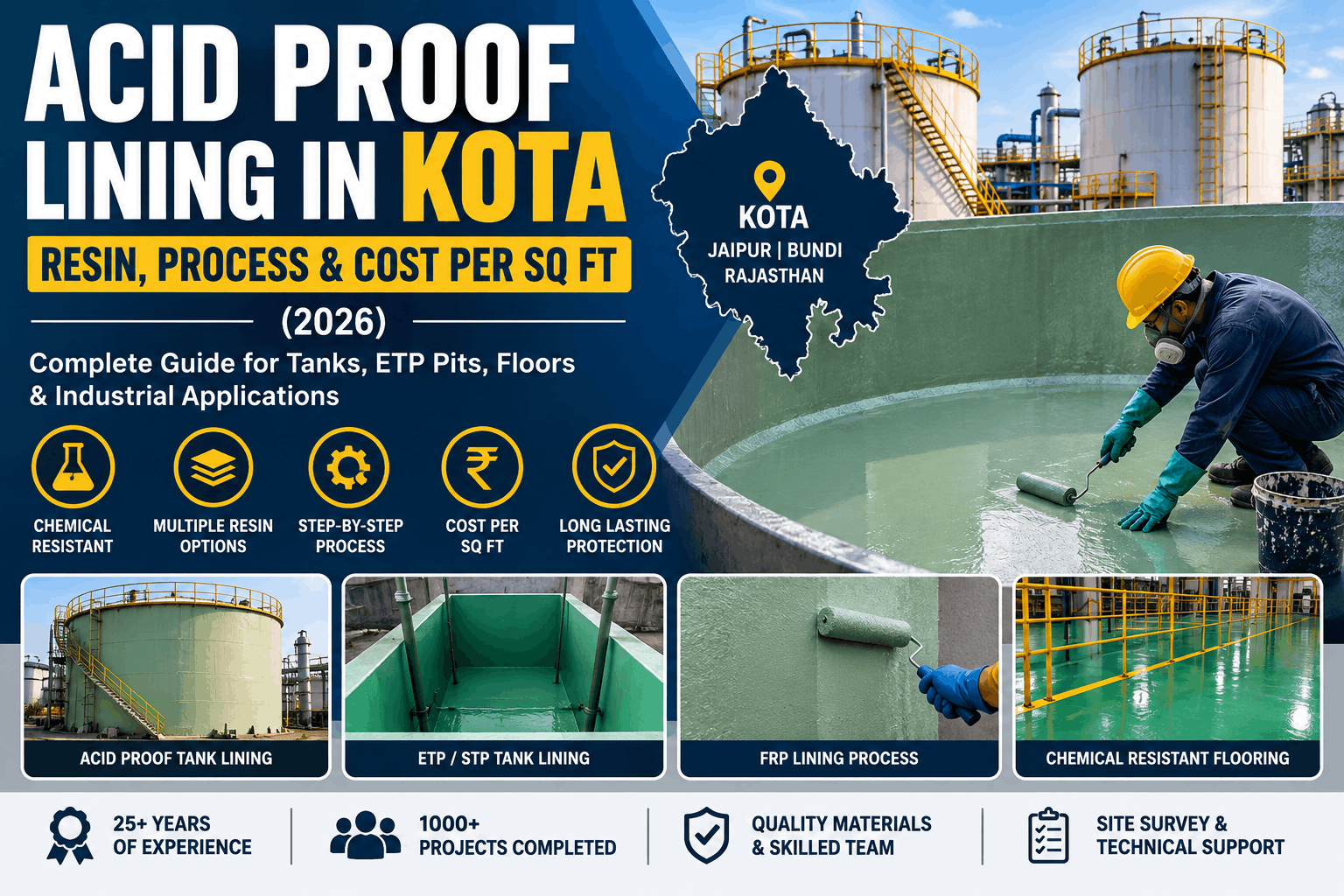
Acid proof lining is not one product. It is three distinct families of system — FRP laminate, brick and tile over a membrane, and coatings — and they are not interchangeable. Quoting the wrong family for a given chemical is the most common and most expensive error in this trade.
The phrase gets used loosely, and that looseness is the source of a lot of mis-quoting.
A resin-and-glass laminate applied directly to the substrate — a resin-rich corrosion barrier facing the chemical, backed by a structural laminate. This is the workhorse for MS and RCC tanks, ETP and STP pits, drains, trenches and floors. Fast to install, repairable in place, and the most common system in this region.
Acid-resistant ceramic or carbon brick, bedded in chemical-resistant mortar, over a flexible membrane. Acid-resistant brick and tile resist essentially the full pH 1–14 range with the notable exception of hydrofluoric acid and related fluoride compounds, and they handle abrasion and high temperature far better than any polymer coating. The trade-off is cost and installation time.
Thinner film builds without glass reinforcement, or with light reinforcement. Good for mild chemical duty, spill containment and hygiene. Not a substitute for a laminate in immersion service.
A serious contractor will tell you which of the three your job actually needs. If a quotation offers the same system regardless of what you are storing, that is a warning sign.
The Kota–Bundi–Rawatbhata belt concentrates fertilizer, chemical, power and effluent-treatment processes in one region — precisely the duty cycles that destroy bare steel and concrete fastest.
Fertilizer manufacturing around Gadepan, chlor-alkali and chemical units, thermal and nuclear power at Rawatbhata, distilleries and edible oil plants, and the effluent treatment infrastructure sitting behind all of them.
The four applications we are called out for most around Kota each have a different failure mode and a different correct specification. Treating them as one job is how tanks end up re-lined twice.
Low pH and hydrogen sulphide attack the cement matrix, carbonate the concrete cover and expose rebar. By the time rust staining shows on the outside face, the cover is usually gone. Typical specification is a 3–4 mm isophthalic or vinyl ester FRP laminate over a fully prepared, dry substrate, with honeycombing and spalled areas repaired first. The common shortcut — coating over crumbling concrete to make it look finished — buys about eighteen months.
Immersion service, and immersion is unforgiving. The corrosion barrier does all the work here and the resin has to be matched to the specific acid at its actual concentration and temperature, not to 'acid' generically. Sulphuric at 98% and sulphuric at 30% are different problems. Vinyl ester is the usual answer; spark testing is not optional.
Acid creeps into construction joints and skirting junctions and undermines the screed from below while the surface still looks intact. Floors need coving at wall junctions, a proper fall to a lined drain point, and an anti-skid topcoat — a smooth acid-resistant floor is a safety liability once it is wet.
Hot acid plus abrasion plus thermal cycling. This is often where brick over membrane genuinely beats FRP, and where a contractor who only sells FRP will quote FRP anyway. Trenches are also the most commonly under-quoted item on any site because linear metres of internal corner take far more labour per square foot than open tank wall.Scrubber sumps and dyke walls built in plain RCC and never coated round out the list.
Seven stages: chemical survey, surface preparation, primer, corrosion barrier, structural laminate, cure and inspection, documentation. Preparation is the majority of the labour and the majority of the cost difference between a ₹45 and a ₹150 per square foot quote. Materials are the minority of the bill.
Step 1 — Chemical and condition survey. Before anything is quoted, three things go on record: the chemical, its concentration, and its operating temperature. Also capture cleaning agents used during shutdown and any credible spill chemistry. A lining specified for the process fluid alone can still be destroyed by the caustic wash nobody mentioned. Resin chemical-resistance data should be traceable to testing in the manner of ASTM C581, not to a supplier's marketing sheet.
Step 2 — Surface preparation. For steel, abrasive blasting to SSPC-SP10 / NACE No. 2 (near-white metal), equivalent to ISO 8501-1 Sa 2½, with an angular profile typically 50–75 microns. Specify the standard in writing — 'sandblasted' means nothing in a contract. For concrete, grinding or scabbling to remove laitance, with moisture content below roughly 4%, verified rather than assumed. All grease, rust, oil and loose material removed; honeycombing and spalled areas repaired first. This step is non-negotiable: a perfect laminate over a contaminated surface will disbond, and it will disbond in sheets.
Step 3 — Primer. A penetrating primer compatible with the chosen resin, applied while the prepared surface is still clean. Timing matters — blasted steel left overnight in Kota's humidity will flash-rust and need re-blasting. Blast and prime the same shift.
Step 4 — Corrosion barrier. The layer that actually does the protecting. A resin-rich inner laminate of surfacing veil backed by chopped strand mat, typically 2.5 to 6.3 mm depending on service severity. Build it to the laminate requirements of ASTM C582, the specification for contact-moulded reinforced thermosetting plastic laminates for corrosion-resistant equipment. For contact-moulded tanks as complete items, ASTM D4097 applies; ASTM D3299 covers filament-wound tanks and is the wrong reference for hand lay-up work, though it is quoted loosely across the industry. The process fluid should only ever touch this barrier.
Step 5 — Structural laminate. Additional plies over the barrier to carry load, resist abrasion and give the lining mechanical integrity. Thickness is a function of tank geometry, head and duty, not a fixed number. Design practice follows BS EN 13121-3:2016, which superseded BS 4994:1987 — BS 4994 is withdrawn but still the document most often named in Indian tender specifications, so expect to see it and know what it means when you do. ASME RTP-1 is the alternative framework where third-party fabricator certification is required.
Step 6 — Cure and inspection. Full cure before return to service; rushing this is a common cause of early failure. Inspection should cover Barcol hardness, laminate thickness checks and, for immersion service, high-voltage spark testing (holiday testing) to find pinholes before the chemical does.
Step 7 — Documentation and handover. Resin grade and batch numbers, measured thickness readings, Barcol results, spark test record. If your contractor cannot hand you this, you have no basis for a warranty claim later.
Choose FRP for chemical immersion at moderate temperature where installation speed and in-place repairability matter. Choose brick over membrane for high temperature, mechanical abrasion, or thermal cycling, where polymer laminates erode or fatigue. Cost separates them by roughly four to six times, so the decision is worth making on evidence rather than habit.
The honest position: for most jobs around Kota, FRP is the correct answer and brick is over-specification. But if the duty is hot, abrasive or thermally cycling, FRP will fail early and the cheaper quote becomes the more expensive job. A contractor who never proposes brick is not offering you a choice.
Realistic 2026 installed rates in Rajasthan: ₹40–70/sq ft for general-duty FRP, ₹80–140 for acid-proof FRP on MS tanks, ₹140–220 for vinyl ester in aggressive acid service, ₹220–350 for novolac or dual laminate, and ₹450–900 for acid brick over membrane. Anyone quoting a firm rate without seeing the site and the chemical is guessing.Thickness, resin grade, substrate condition, access and preparation volume move the number by a factor of four or more.
What pushes a quote up: heavy surface preparation (pitted steel, spalled concrete, old failed coating to strip) · confined space or working-at-height access · shutdown windows requiring night or multi-shift working · small areas, since mobilisation cost is fixed regardless of square footage · higher-grade resin, correctly specified.
What pulls it down: clean new substrate · large continuous area · flexible schedule · work bundled with other jobs in the same shutdown.
On comparing quotes: a rate per square foot is meaningless without the specification behind it. Ask every bidder for resin grade, total laminate thickness, ply schedule, surface preparation standard (as an SSPC or ISO designation, not an adjective) and whether spark testing is included. Two quotes differing by 60% usually differ on those five lines, not on margin.
In order of frequency from jobs we have been called in to repair: wrong resin, inadequate surface preparation, moisture in the substrate, insufficient cure, and no holiday testing. Four of the five are specification and supervision failures, not material failures.
Six questions. If a bidder cannot answer the first two before quoting, the rest does not matter.
We are based in Kota and carry out acid proof lining, FRP lining, tank fabrication and on-site repair across Kota, Bundi, Rawatbhata, Jaipur and the wider Hadoti belt. We stock over 1,000 FRP and MRO items, so a lining job does not stall waiting for resin or mat to arrive from out of state.
If you want the specification checked before you go to tender, send a photograph of the tank or floor and tell us what it holds. We will tell you what system it needs — including when the honest answer is that a repair will do and a full re-line is not warranted.
Call +91 94605 68660, or see our full FRP lining services in Rajasthan and acid proof lining services in Kota.