Acid-Proof & Chemical-Resistant FRP Lining in Kota, Rajasthan
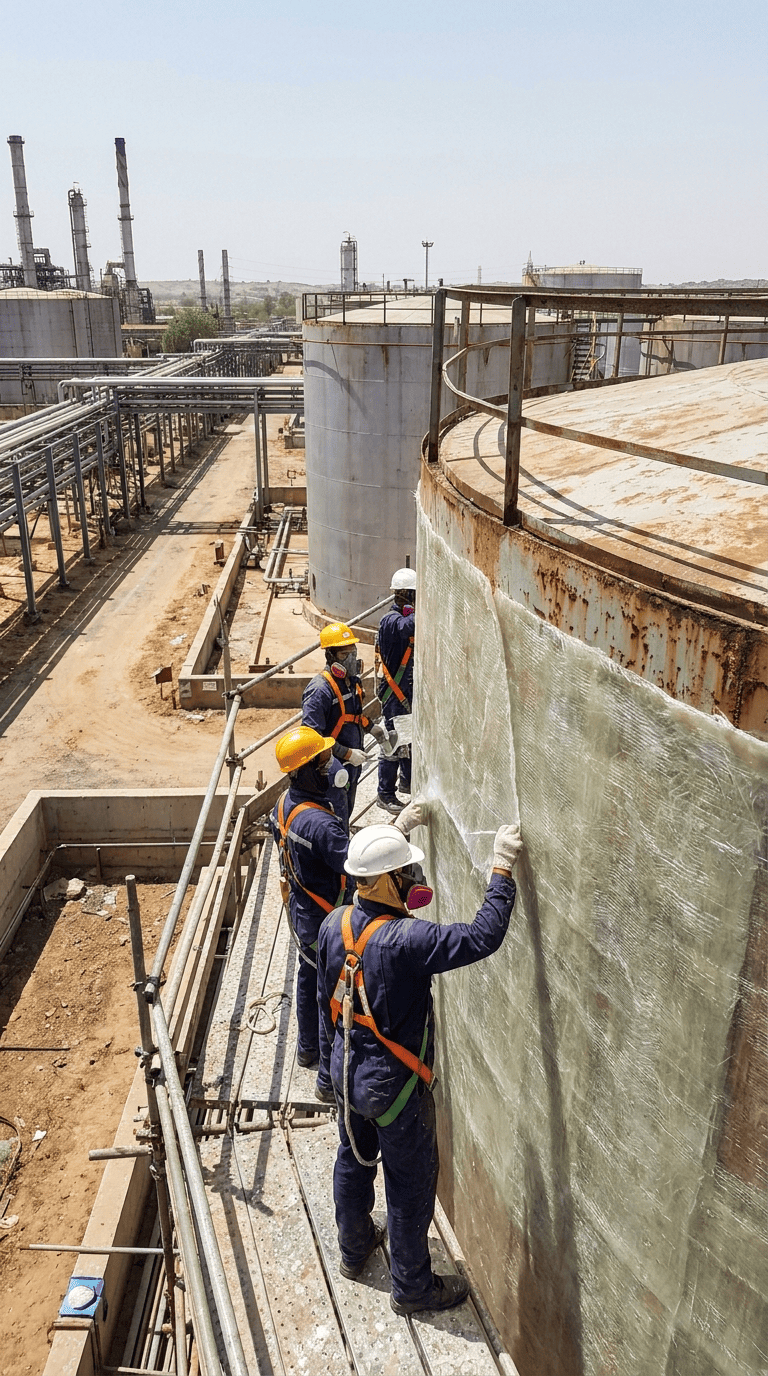
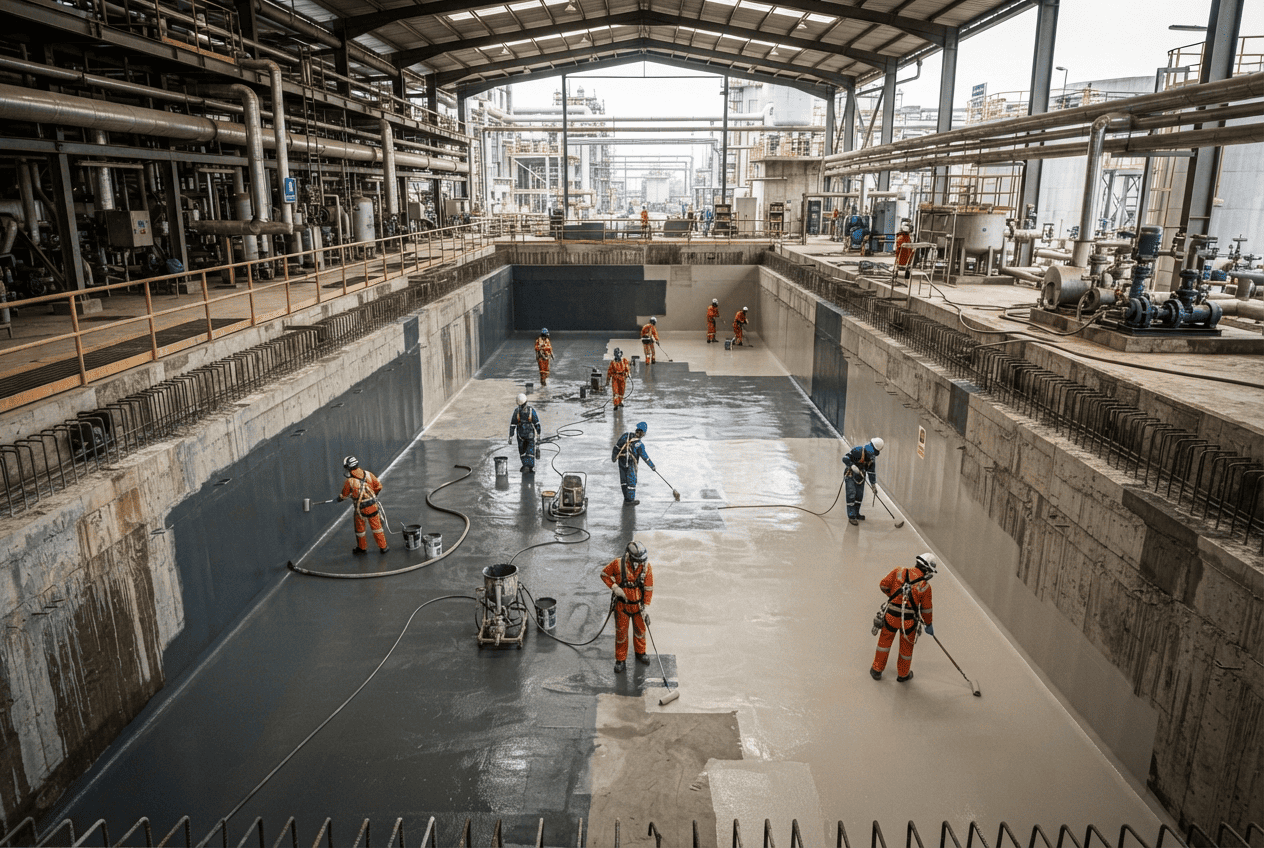
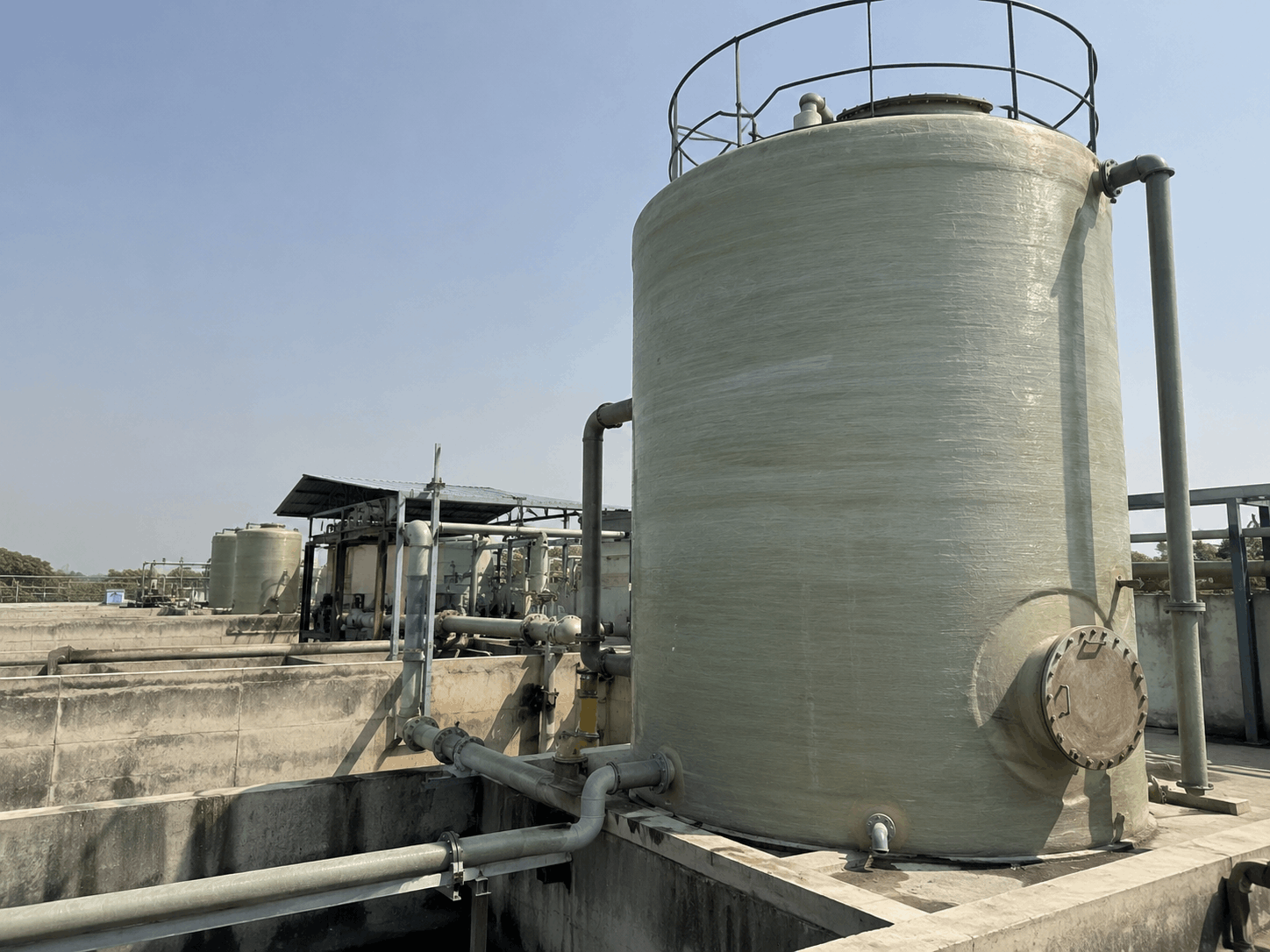
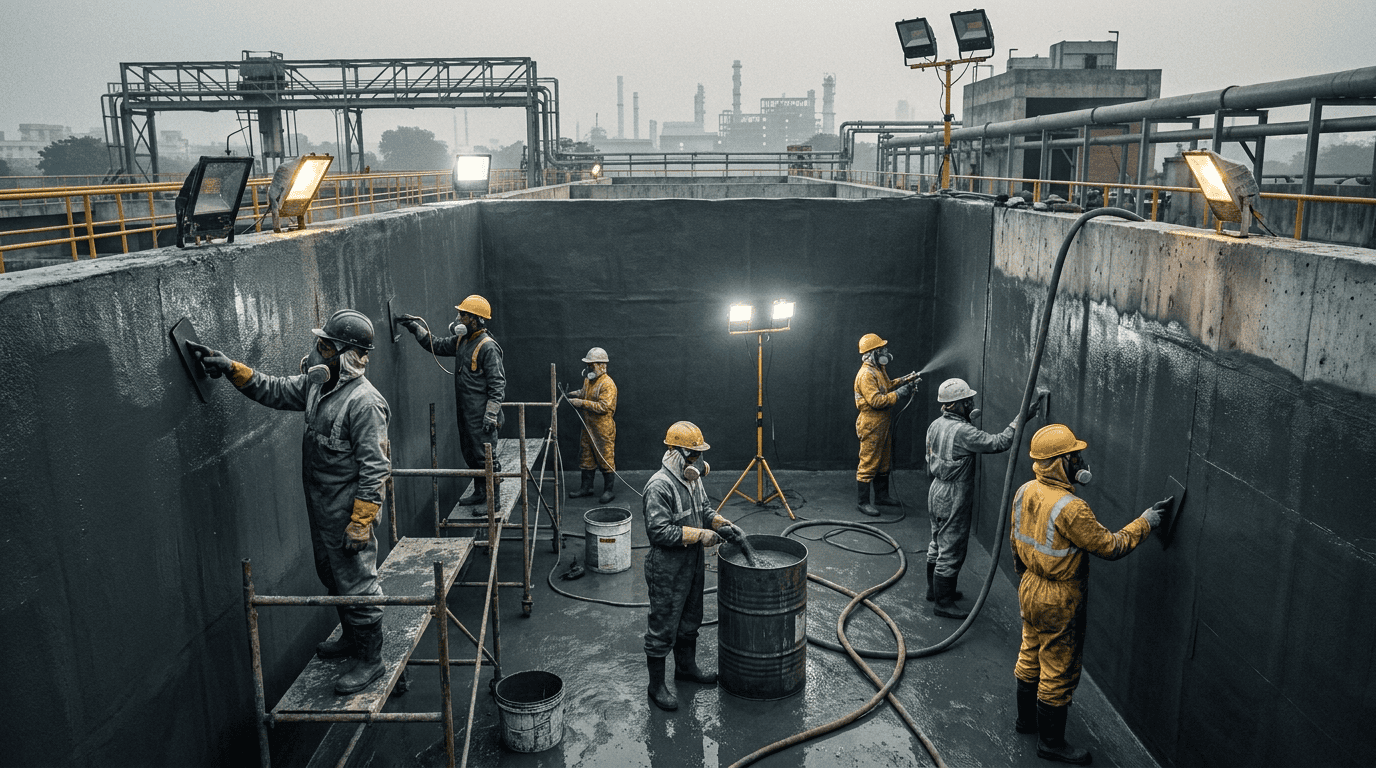
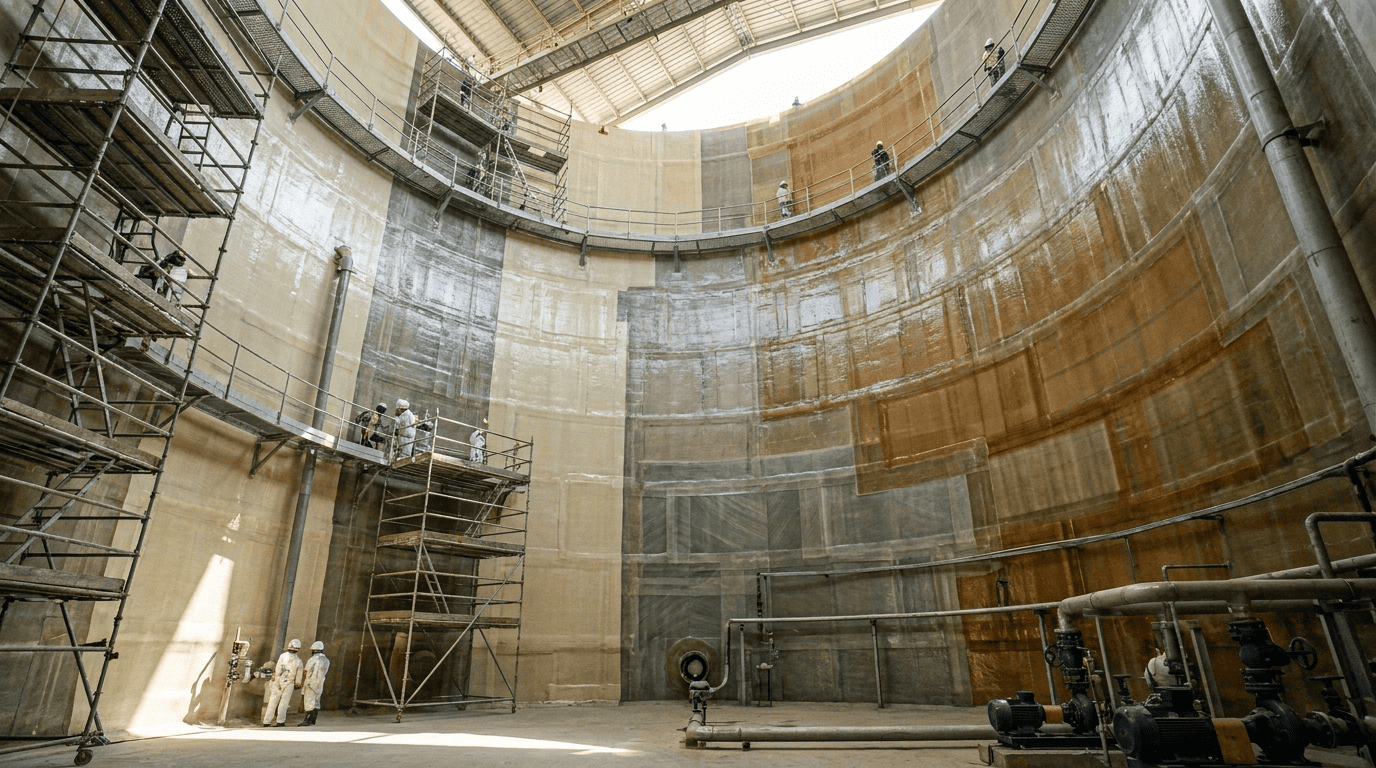
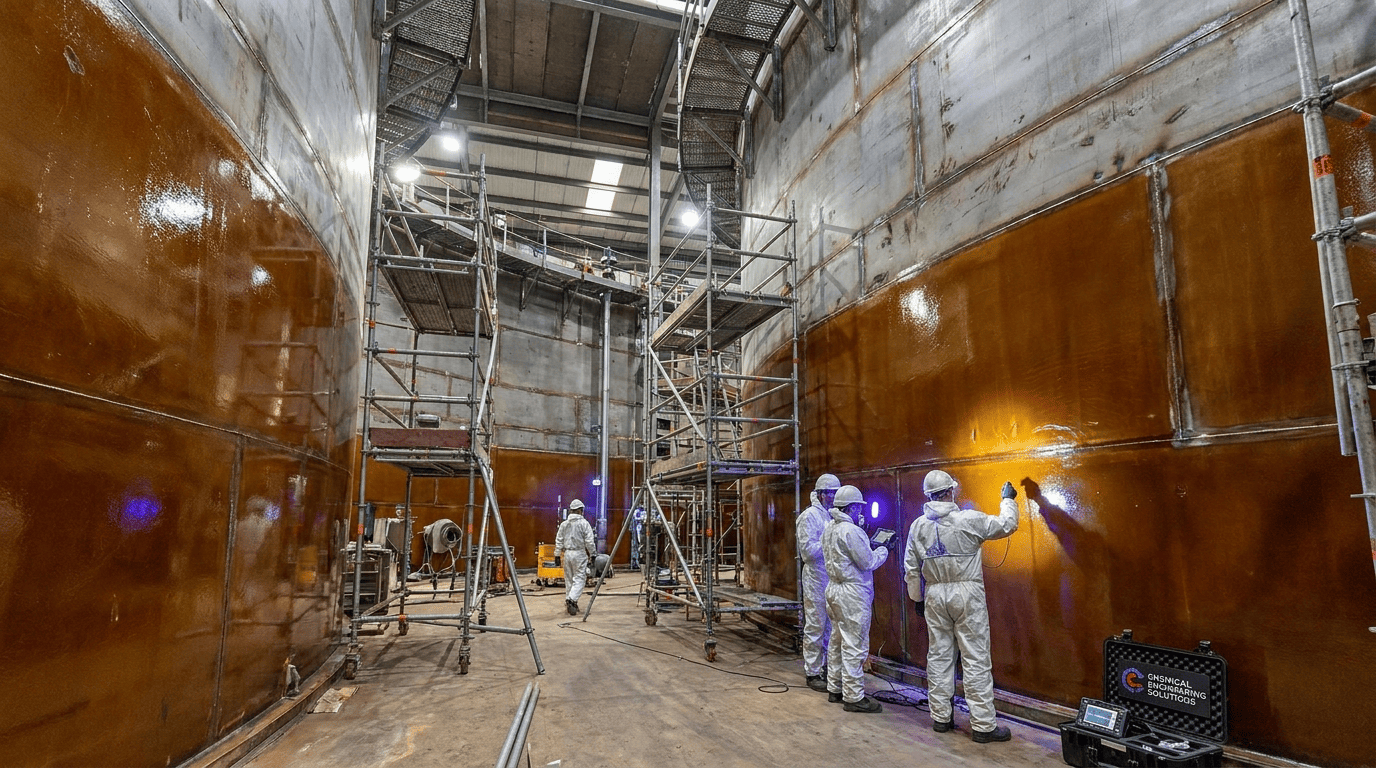
Acid-proof FRP lining is a bonded, seamless composite barrier — not a paint or a coating — built up directly onto steel or concrete to stop chemical attack. Shri Ganesh Sales has been applying it across the Kota–Bundi–Rawatbhata industrial belt for over 25 years, and we specify the laminate against the chemical you actually run: its concentration, and its temperature. That single decision determines whether the lining lasts a decade or blisters within a year. We line MS and RCC storage tanks, ETP and STP pits, pickling tanks, dyke walls, trenches, process floors and vessels — on site, around your shutdown window.
ISO Compliant processes for maximum corrosion resistance.
25+ Years in the Kota Market
Chemical-Matched Resin Selection
GST-Registered
Same-Day Site Visits Across the Kota Region
Shutdown & Emergency Support
25+ Years in the Kota Market
Chemical-Matched Resin Selection
GST-Registered
Same-Day Site Visits Across the Kota Region
Shutdown & Emergency Support
Corrosion Doesn't Wait for Your Next Budget Cycle.
Unprotected mild steel in acid service can perforate within months. Concrete does not fare better — low-pH effluent eats cement paste, exposes aggregate and then attacks rebar, and by the time seepage shows on the outside of an ETP wall, the damage inside is well advanced. Shri Ganesh Sales provides acid-proof and chemical-resistant lining for mild steel storage tanks and vessels, RCC pits, trenches and dyke walls, ETP and STP civil tanks, pickling and dosing tanks, plant floors, battery rooms, drains and sumps — across Kota, Bundi, Rawatbhata, Jaipur and project sites throughout Rajasthan. We have supplied and serviced this region's industry for more than 25 years, and some of the tanks we lined years ago are still holding acid today.
25+ Years of Proven Protection
Serving industrial hubs across Rajasthan: Kota, Bundi, Rawatbhata, Jaipur.
Regional Authority
Engineered for the specific thermal and chemical profiles of North Indian industrial clusters.
Protected Assets
Storage Tanks & Vessels
RCC Pits & Trenches
Dyke Walls & ETP/STP Tanks
Pickling & Dosing Tanks
Plant Floors & Battery Rooms
Drains & Sumps
Which type of FRP lining is suitable for my chemical?
The correct FRP lining system depends on the chemical being handled, its concentration, operating temperature, exposure conditions and the substrate being protected. Different industrial chemicals require different corrosion-resistant laminate systems, so there is no single FRP lining specification suitable for every application.
At Shri Ganesh Sales, we assess your operating conditions and recommend the appropriate lining system for the application. This ensures the lining is designed for the actual chemical service rather than using a generic specification. We undertake chemical-resistant FRP lining for applications involving:
Chemicals We Protect
Hydrochloric acid (HCl)
Sulphuric acid
Nitric acid
Phosphoric acid
Caustic soda and alkaline solutions
Fertilizer and process chemicals
Industrial effluent and wastewater
Chlorine-containing environments
Pickling and plating chemicals
Other corrosive industrial chemicals
What We Need to Specify Your Lining
1
Chemical name
What chemical will come into contact with the lining?
2
Concentration
What is the approximate concentration or strength?
3
Operating temperature
What is the normal and maximum operating temperature?
4
Equipment or structure
Tank, RCC pit, ETP/STP tank, floor, trench, vessel, etc.
5
Existing condition
New construction, bare steel/concrete, existing FRP, etc.
Send Us Your Details
Get the Right Lining for Your Chemical
Send us these details or simply WhatsApp photographs of the tank or affected area.
We specify the lining for your chemical service rather than offering a one-size-fits-all coating.
Our goal is long-term performance, safety and reliability for your critical equipment.
How thick should acid-proof lining be?
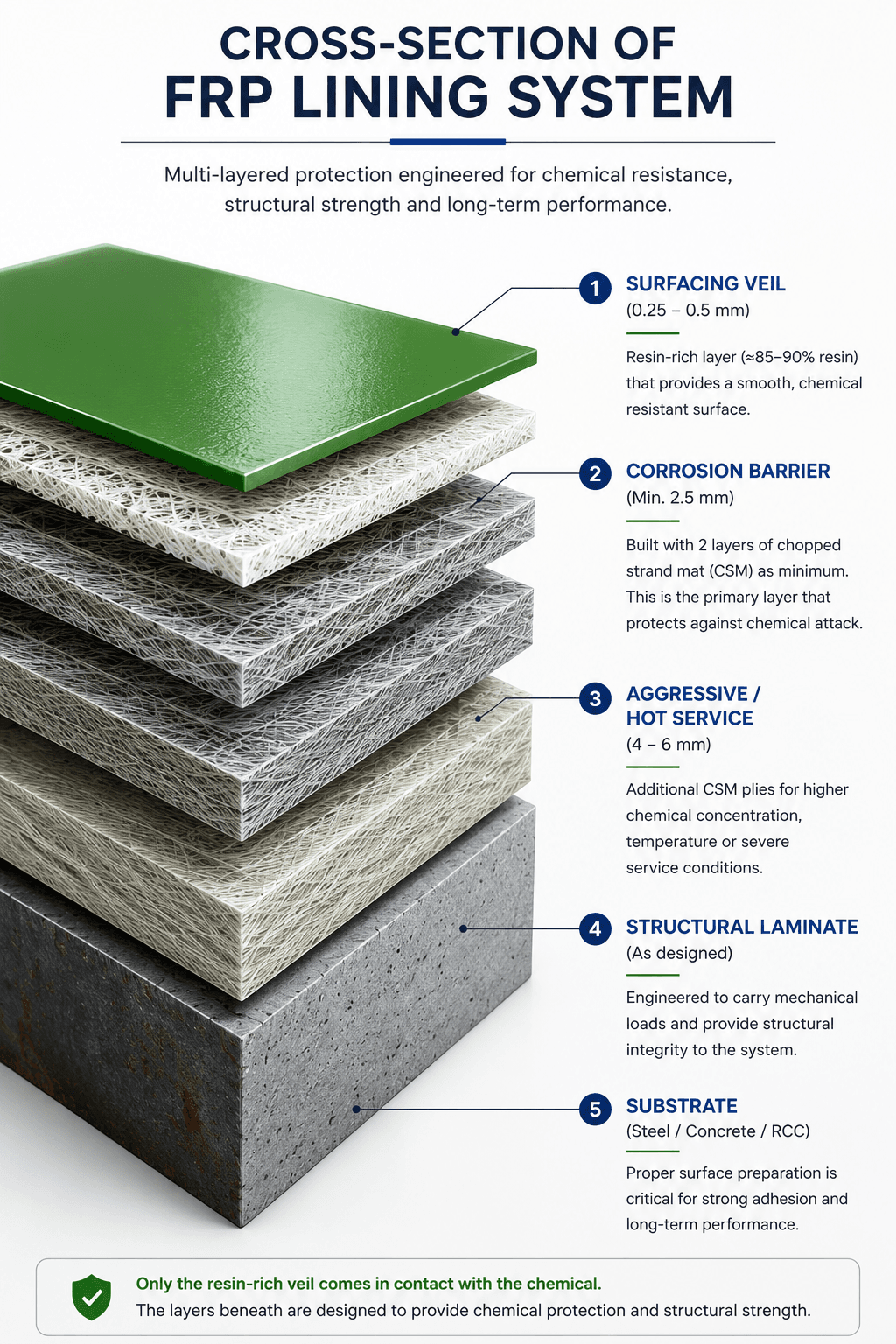
The corrosion barrier — the layer actually doing the chemical protection — should be a minimum of 2.5 mm. That figure comes from established FRP design practice under BS 4994 (design of vessels and tanks in reinforced plastics) and ASTM D3299 (filament-wound glass-fibre-reinforced thermoset resin chemical-resistant tanks).
The chemical only ever contacts the resin-rich veil. Everything behind it is there to carry load.
A 1 mm "acid-proof lining" is a paint job with a different name.
If a quotation doesn't state the corrosion-barrier thickness and the resin grade, it isn't a specification — it's a price.
2.5 mm minimum corrosion barrier for chemical protection
Higher temperature or concentration = extra protection
Always ask for written specification, not just a price
We follow BS 4994 & ASTM D3299 design principles
How much does acid-proof lining cost in India?
There is no single per-square-foot price for acid-proof FRP lining. The final cost depends on the chemical service, required lining system, thickness, substrate condition, site access and installation requirements. For this reason, we recommend site-specific pricing rather than a generic rate quoted over the phone. Two tanks with the same surface area can have very different project costs depending on their condition and operating requirements.
That spread is wide for a reason. Six factors drive where your job lands — and we go through the published rate bands in more detail in our guide to FRP lining cost in Rajasthan:
1
Resin grade
The single biggest lever. Novolac vinyl ester resin can cost several times GP polyester per square metre. It is also the last place to economise — resin is a small share of project cost and decides the entire service life.
2
Laminate thickness
A 2.5 mm barrier and a 6 mm heavy-duty build are different jobs in both material and labour hours.
3
Surface preparation
Abrasive blasting a pitted steel tank costs more than sanding a sound one. Concrete needing scabbling and blowhole filling costs more than a smooth new pour.
4
Access and geometry
Confined-space entry, scaffolding, overhead work, and vessels full of internals all add hours. A flat floor is quick. A tank with nozzles and baffles is not.
5
Shutdown window
Night shifts, weekends and hard turnaround deadlines carry a premium.
6
Area and location
Larger areas bring the per-sq-ft rate down. Sites inside the Kota–Bundi–Rawatbhata belt avoid mobilisation charges entirely.
Execution Protocol
How we execute the work
Most lining failures are not resin failures — they are preparation failures.
Here is the actual sequence:
1
Site inspection and survey
We visit, measure, and assess substrate condition. On steel we check pitting depth and weld quality; on concrete, age, moisture and any existing coating.
2
Substrate preparation
Non-negotiable, and where cheap contractors cut corners.
Carbon steel
Abrasive blast to Sa 2½ (ISO 8501-1) with an angular anchor profile of 50–75 microns. Priming follows immediately, before flash rust forms.
Concrete / RCC
Structure must be fully cured and dry — we test substrate moisture before starting, because trapped moisture is the most common cause of blistering months later. Laitance is ground or scabbled off, blowholes filled with resin putty, and a cove fillet formed at every floor-to-wall junction so the laminate never turns a sharp 90°.
Existing FRP
Gloss ground back to expose fresh laminate for a chemical bond.
3
Corrosion barrier lay-up
Resin-rich surfacing veil first, then two layers of chopped-strand mat, to 2.5 mm minimum.
4
Structural laminate
Plies built to required thickness, controlling exotherm between layers so the laminate does not crack from its own cure heat.
5
Cure and inspection
Barcol hardness reading to confirm cure, thickness verification, and — where service justifies it — a high-voltage spark test across the lined surface to find pinholes and holidays invisible to the eye.
Nothing is handed over undercured: an undercured laminate has not reached full crosslink and will be attacked by the very chemical it was built for.
6
Handover
Cured, inspected, back in service.
Failure Analysis
Why acid-proof lining fails — and how we prevent it
In our experience across 25 years in Kota, five causes account for nearly every premature lining failure:
Cause
What you see
Prevention
Wrong resin for the chemical
Blistering, softening, resin whitening within months
Specify by chemical + concentration + temperature
Moisture in the concrete
Osmotic blisters, disbondment in sheets
Moisture test before lay-up; never rush a green pour
No anchor profile on steel
Lining peels away intact
Blast to Sa 2½, 50–75 µm profile
Undercure
Soft laminate, chemical attack from day one
Barcol reading before handover
Missing cove fillet
Cracking at the floor–wall junction
Radius every 90° internal corner
Had a lining or epoxy system fail on your site?
Tell us what happened. The failure mode usually identifies the mistake, and it tells us what to specify instead.
Kota sits in one of India's more corrosion-intensive industrial regions, which is exactly why this work exists here.
3.4 MMTUrea capacity, Gadepan
1,180 MWSix PHWR units, Rawatbhata
35 kmKota to Gadepan
25+ yrsServing the Hadoti belt
Fertilizer
Gadepan · 35 km from Kota
Chambal Fertilisers operates three urea plants totalling around 3.4 million MT per year — roughly a tenth of India's urea output — alongside about 1.3 million MT/year of ammonia. Its expansion added a weak nitric acid plant (210,000 t/yr) and technical ammonium nitrate capacity (240,000 t/yr), both brought online through 2026.
Nuclear and thermal power
Rawatbhata · Kota
Rajasthan Atomic Power Station at Rawatbhata runs six PHWR units (1,180 MW), with RAPS-7 (700 MW) grid-connected in March 2025 and RAPS-8 in commissioning. Kota Super Thermal Power Station adds demand for cooling-water, effluent and DM-plant corrosion protection.
Chemical, pharma, agro and ethanol
Kota Industrial Area · Bundi · Hadoti belt
The RIICO estates around Kota — Indraprastha, Chambal and Hadoti among them — run HCl, caustic, sulphuric acid and process liquors through tanks and pits that bare concrete cannot survive. Hadoti is also turning into an ethanol belt: two grain distilleries are already running and three more are under construction, among them Pingaksh Beverages at Talera in Bundi, at roughly 250 KLPD.
Distillery spent wash and pharmaceutical effluent are low-pH, high-solids streams — they need lined collection pits and ETP tanks, not bare RCC.
By equipment
MS and RCC storage tanks
Pickling and plating tanks
ETP/STP collection pits
Neutralisation and equalisation tanks
Dyke walls and bunds
Process floors and battery rooms
Trenches and drains
Reaction vessels
DM plant structures
Effluent gutters
Coverage & Track Record
Where we work
Kota is our base, and the bulk of our work sits inside the Kota–Gadepan–Bundi–Rawatbhata belt.
Core belt
Kota Industrial Area · Gadepan · Bundi · Rawatbhata
Most of these plants are a short drive from our godown — which is why we can measure in the morning and quote the same afternoon.
Acid-proof lining anywhere in the state where the scope justifies mobilising a team.
Project record
Site
Chemical processing unit, Kota Industrial Area
Problem
RCC effluent collection pit of roughly 40 KL, handling process effluent swinging between pH 1.5 and 3. Two years after commissioning there was seepage staining down the outer dyke wall and exposed aggregate along the inner face at the waterline.
Diagnosis
The pit had been given two coats of epoxy paint at around 300 microns, applied over a pour that had not dried. Trapped moisture drove osmotic blistering from behind, and laitance had never been removed — so what adhesion there was came from a skin of cement paste that lifted with the coating. A paint film was never going to hold that pH in the first place.
Downtime
9 days including cure, taken inside a planned plant shutdown.
Specification
Scabble back to sound concreteSubstrate moisture tested before lay-upBlowholes filled with resin puttyCove fillet at every floor–wall junctionC-veil + 2 × CSM corrosion barrier, 3 mmBisphenol-A epoxy vinyl esterStructural plies to 5 mm totalBarcol reading and spark test at handover
Result
Back in continuous service. Inspected at 14 months — no blistering, no softening at the waterline, cove fillets intact.
The Short Version
Why plants in Kota, Rajasthan call us
25 years
We spec to your chemical, not to a price point.
25 years in this market means we have seen which systems come back and which don't. We'll tell you when GP resin is genuinely adequate — and when it absolutely isn't.
1,000+ SKUs
Material is in stock, in Kota.
1,000+ FRP and MRO SKUs held locally. A lining job doesn't stall waiting for a resin truck from Ahmedabad.
Written scope
We visit before we quote.
Inspection and measurement first, then a written scope naming resin grade, thickness and timeline. No blind per-square-foot estimates.
Nights & weekends
We work to your shutdown.
Lining is a turnaround job. We plan around your window, including nights and weekends.
Within 4 hours
We answer fast.
Industrial buyers typically message three to five vendors at once and go with whoever responds first. Most of our quotations go out within 4 hours.
For HCl at ambient temperature, a bisphenol-A epoxy vinyl ester handles the full concentration range and is the standard specification. General-purpose polyester is not suitable at any concentration. If the acid is hot, or chlorine is present in the vapour space, move up to novolac vinyl ester or a dual-laminate construction.
Can you line RCC and concrete tanks, or only steel?
Both. Concrete lining is a large part of our work — ETP pits, neutralisation tanks, dyke walls and trenches are usually civil structures. Concrete needs different preparation from steel: fully cured, dry, laitance removed, blowholes filled, cove fillets at wall junctions. We test substrate moisture before starting, because moisture trapped under a laminate is the most common cause of blistering later.
How thick should acid-proof lining be?
Minimum 2.5 mm for the corrosion barrier, following BS 4994 and ASTM D3299 practice. For aggressive chemicals, elevated temperature or abrasive service, 4–6 mm. Total laminate may be thicker again where the lining also carries structural load.
How much does acid-proof lining cost per square foot?
Published Indian rates for FRP lining run roughly ₹40–₹175 per sq ft depending on resin grade, thickness, surface preparation and access. Vinyl-ester systems sit at the upper end. We give a firm figure after a site visit — anyone quoting acid-proof lining over the phone without knowing your chemical is guessing.
How long does the plant have to be down?
For a typical tank, several days: preparation, lay-up and cure. Cure is temperature-dependent and cannot be rushed without compromising the laminate. We confirm realistic dates at quotation stage and plan around your turnaround.
How long will the lining last?
Correctly specified and correctly applied, acid-proof FRP lining in appropriate service gives many years with minimal maintenance — comfortably outlasting coated steel, because a resin corrosion barrier does the work rather than a paint film. Actual life depends on resin grade, chemical, concentration and temperature.
What is the difference between acid-proof FRP lining and acid brick lining?
Acid brick is a mortar-jointed system, so it has joints — and joints are where acid eventually penetrates, which is why brick linings need periodic re-pointing. FRP lining is monolithic and seamless with nothing to re-point. Brick still wins in high-temperature and heavy-abrasion duty. FRP is lighter, faster to install and lower maintenance. Cost-wise, acid-resistant brick lining starts around ₹2,100/sq m against roughly ₹40–₹175/sq ft for FRP.
Can you line over an existing damaged lining?
Sometimes. If the existing laminate is sound and well bonded, we prepare it and overlay. If it has disbonded, blistered or is undercured, it must come off first — laminating over a failing bond buries the problem rather than solving it. We assess on site and tell you honestly which one you have.
Do you carry out lining during a running plant?
The lined area must be out of service, drained, cleaned and safe to enter — resin will not bond to a wet or contaminated surface, and cure needs ventilation. The rest of the plant usually keeps running. We regularly work on one tank while the adjacent line stays live, under the appropriate work permits.
Do you work outside Kota?
Yes. Kota, Bundi, Rawatbhata and Gadepan are routine. We work in Jaipur regularly and take project-based lining work across Rajasthan.