
Technical Engineering Hub
Industrial Insights, Products & Supplier Guides by Shri Ganesh Sales
Explore industrial supplier insights, product guides, and location-based solutions across Kota, Jaipur, and Rajasthan
Explore industrial supplier insights, product guides, and location-based solutions across Kota, Jaipur, and Rajasthan

Published: September 17, 2026
Quick answer: Most leaking or blistering FRP tanks do not need replacing. If the tank's structure is still sound, a patch repair (₹4,000–₹25,000) or a full re-line (₹45–₹150 per sq ft) restores it for a fraction of the cost of a new tank, usually within a planned shutdown. Replacement makes sense only when the structure itself has failed: through-wall damage in several places, deep delamination, a deformed shell, or concrete that has lost its strength.
Almost every week, a maintenance engineer from Kota, Gadepan or Jaipur sends us a photo of a weeping tank with the same question: 'Tank repair karein ya naya lein?' Should we repair it, or buy a new one?
It's a fair question, and the wrong answer is expensive either way. Replace a tank that only needed a re-line and you've spent lakhs you didn't have to, plus weeks of downtime. Patch a tank whose structure has already gone and you'll be back in a few months, often with a bigger leak.
We have been carrying out FRP tank repair, lining and fabrication across the Kota–Bundi–Rawatbhata belt for more than 25 years. This guide sets out how we make the repair-or-replace call on site, what each option realistically costs in Rajasthan in 2026, and the signs that tell you which way your tank is heading.
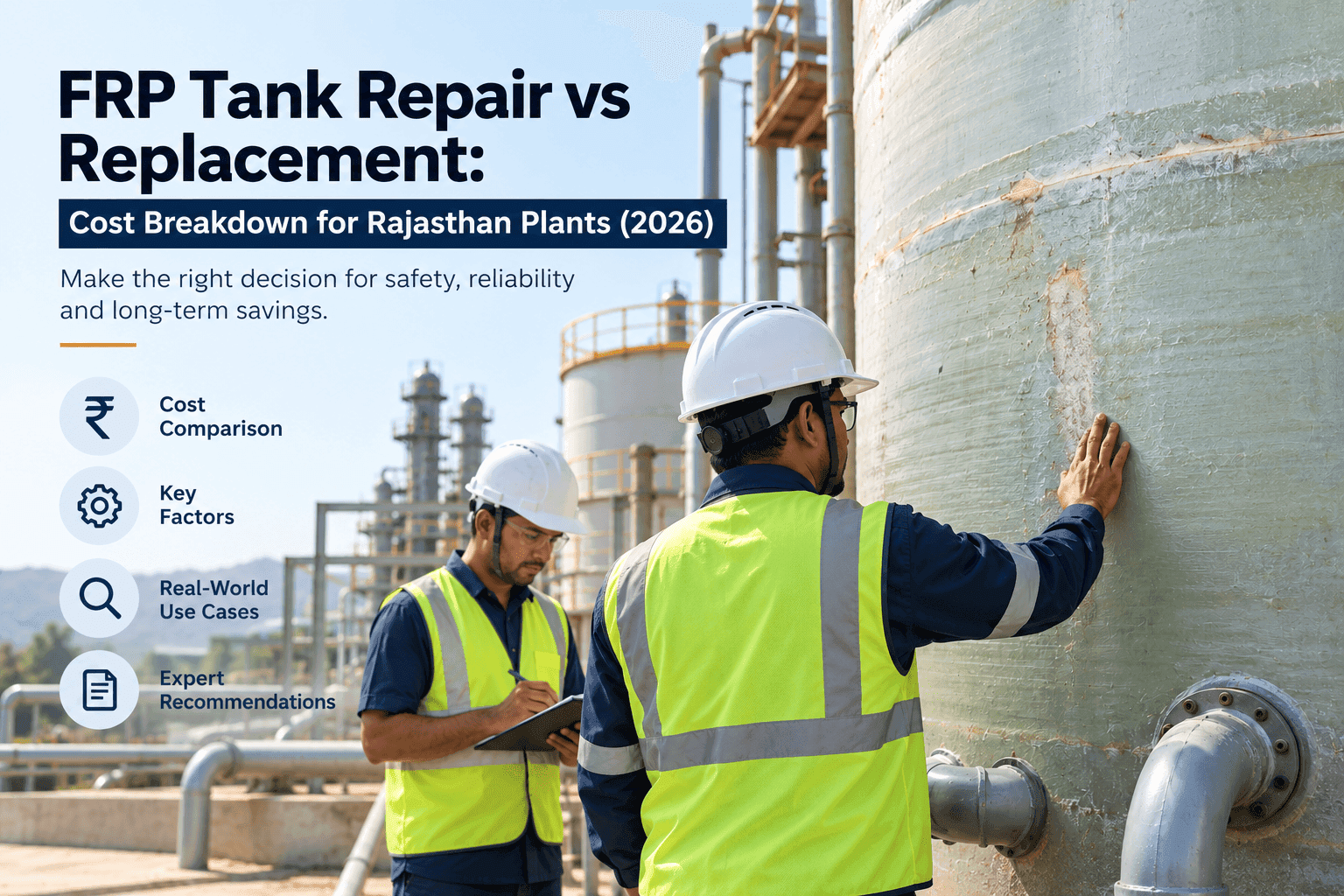
In Indian plants, 'FRP tank' can mean three quite different things. The repair method, and the cost, depends on which one you have.
1. All-FRP tanks. The whole tank is made of glass fibre and resin: a chemical-resistant inner layer (the corrosion barrier) backed by a thicker structural layer. Repair here means removing damaged laminate and building new laminate back up to the right thickness.
2. PP-FRP or dual-laminate tanks. A welded polypropylene (PP) inner liner holds the chemical, and an FRP outer shell carries the load. These are common for HCl, alum and caustic dosing. When a PP-FRP tank leaks, the fault is usually a cracked PP weld or a stress crack near a nozzle, so the fix starts with PP re-welding and leak testing. Resin work comes afterwards, and only if the FRP shell has been affected.
3. FRP-lined MS or RCC tanks. A mild-steel tank or a concrete pit (ETP, STP, neutralisation) with an FRP lining applied inside. Here the lining protects a steel or concrete structure. Repair means fixing or replacing the lining, but only after confirming the steel or concrete behind it is still strong enough.
Knowing which type you have matters because 'repair' means something different for each. A contractor who quotes the same fix for all three without asking hasn't really looked at your tank.
Patch repair fixes a local problem: one leak point, a crack, impact damage, or a leaking nozzle or manhole joint. The damaged area is ground back to sound laminate, the surface is prepared, and new layers are built up over and beyond the damaged zone. On most tanks this is a one-day job.
Full re-line replaces the corrosion barrier across the whole inside of the tank. It's the right choice when blistering, crazing (fine surface cracks), softening or discolouration has spread over large areas, but the structure behind it is still sound. The old barrier is removed, the surface is prepared, and a new barrier is built. If the chemical has changed since the tank was made, this is the time to upgrade the resin. Around 70% of the jobs we do fall in this category.
Replacement means removing the tank and installing a new one. It's the only honest answer when the structure itself is compromised. It is also the option with the most hidden costs, covered in the next section.
| Option | Typical scope | Typical downtime | What you get |
|---|---|---|---|
| Patch repair | Local leak, crack, nozzle or manhole | About 1 day including cure | Local damage fixed; rest of tank carries on as before |
| Full re-line | Widespread barrier damage, sound structure | 1–4 days depending on size | New corrosion barrier; typically 10–20 years in correctly specified chemical service |
| Replacement | Structural failure | Fabrication lead time (often 2–3 weeks) plus removal and installation | New tank, which will itself need maintenance and eventually a re-line |
These are realistic installed rates for industrial jobs in Rajasthan. They match our FRP lining rate per sq ft in Rajasthan guide, which has the full rate card. GST at 18% is extra.
| Work | 2026 rate (Rajasthan) |
|---|---|
| FRP patch repair / leak sealing | ₹4,000 – ₹25,000 lump sum |
| Re-line, MS tank, general duty (GP resin, ~2.5 mm) | ₹45 – ₹70 per sq ft |
| Re-line, MS tank, chemical duty (isophthalic, ~3 mm) | ₹60 – ₹90 per sq ft |
| Re-line, acid service (vinyl ester, 3–4.5 mm) | ₹90 – ₹150 per sq ft |
| Re-line, RCC / concrete (ETP, STP, pits) | ₹65 – ₹110 per sq ft |
| New PP-FRP tank (tank only, indicative market listings) | Roughly ₹15 – ₹50 per litre of capacity |
Small one-off jobs usually carry a minimum job value of about ₹15,000–₹25,000, because mobilising a crew costs the same for 100 sq ft as for 400. On badly pitted steel or tanks with a failed old lining, surface preparation alone can add 20–30% to the re-line cost.
A new tank's price is only the starting point. When you compare it with a re-line, add these line items to the replacement side:
A re-line, by contrast, happens inside the tank you already have. The nozzles, foundation and piping stay where they are.
The example below is illustrative. Your own tank's numbers will differ, which is why we measure before we quote.
The tank: a 10 KL vertical tank, about 2.2 m in diameter and 2.65 m high, storing dilute hydrochloric acid. Blistering covers much of the inner surface, but a tap test shows the structural laminate is sound.
For a real job from our records: in April 2026 we re-lined a 15 KL mild-steel chemical storage tank at a chemical unit near Gadepan, Kota. The work covered about 420 sq ft with an isophthalic resin system and a 3 mm laminate. It was completed within a planned 2-day shutdown, and the tank was pressure-tested before handover.
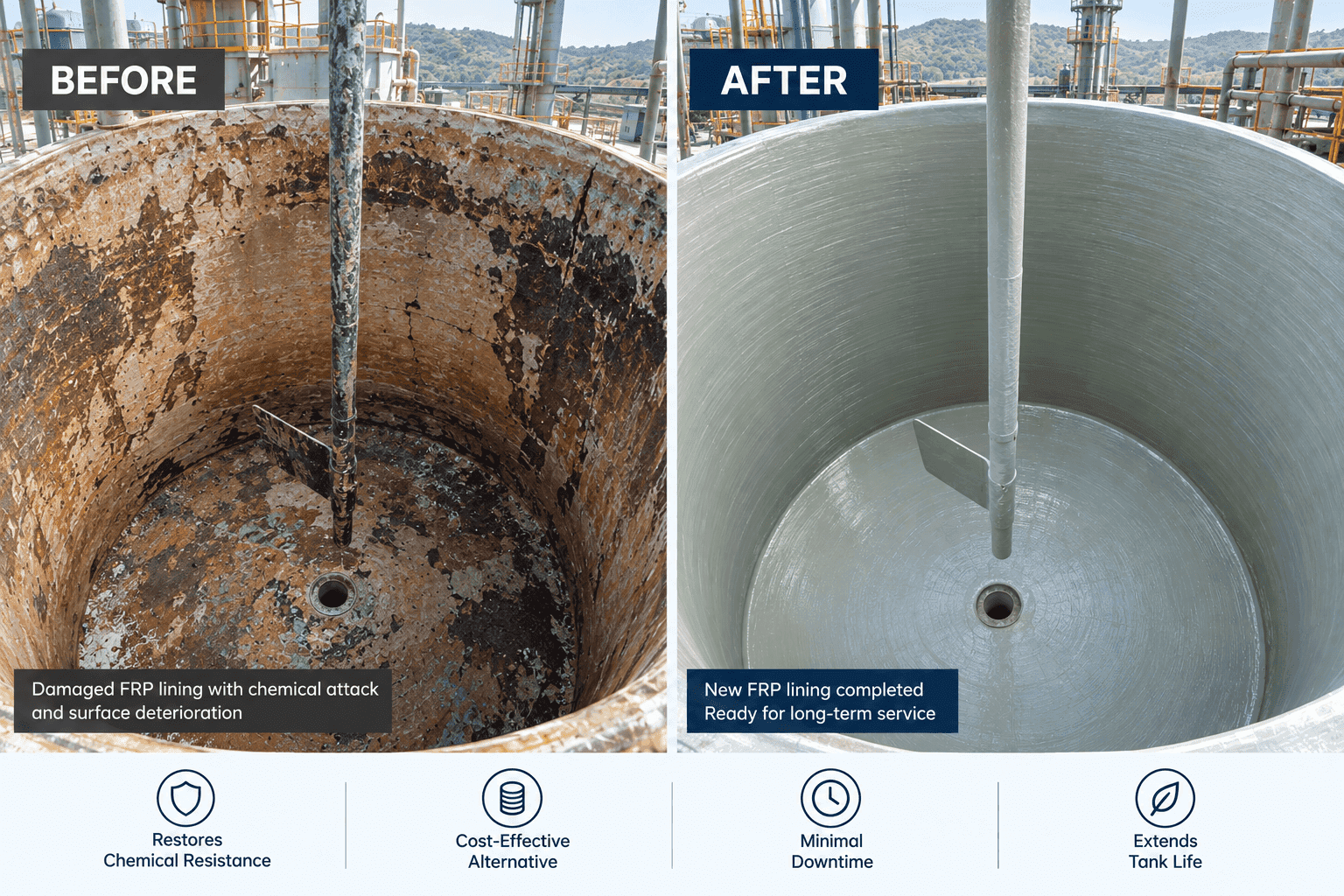
Several through-wall leaks in different areas of an all-FRP tank.Deep delamination. The layers of the structural laminate are separating, not just the inner barrier.Bulging, sagging or a deformed shape. The tank can no longer hold its geometry under load.Clusters of holes in an MS tank's shell, or widespread steel loss that lining cannot bridge.Repairs failing in the same spot. This points to structural damage, or a resin that doesn't suit the chemical at all. The underlying cause has to be fixed, which may mean a new tank.
For RCC tanks with widespread cracking or badly corroded reinforcement, get a structural engineer's opinion before any lining work. Lining protects concrete; it cannot make weak concrete strong again. Any contractor who claims otherwise is selling you two failures.
We don't give a repair-or-replace answer from a single photo. A photo tells us where to look; the site visit tells us what we're dealing with. On site, we:
Our laminate work follows recognised practice for hand-laid, corrosion-resistant FRP. That means ASTM C582 for the laminate itself, and ASTM D4097 for hand-laid tanks as complete items. BS EN 13121-3 is the current European design standard; it replaced BS 4994, which is still commonly named in Indian tenders. ASTM D3299 is often quoted loosely, but it covers filament-wound tanks, not hand lay-up repair work.
You receive the findings in writing, along with the resin grade, layer schedule and test results once the work is done. For step-by-step detail on the lining process, see how acid proof lining is applied.
Sometimes a tank could be repaired, but replacement is the better business decision:
The plant needs more capacity or a different nozzle layout, and a re-line doesn't solve that.The tank sits in the wrong place, for example blocking access or lacking proper secondary containment, and a planned move is coming anyway.The service is changing a lot. A move to a much hotter or more aggressive chemical may be beyond what the existing structure was designed for. That said, a re-line with an upgraded resin handles many chemical changes; see our guide on choosing resin for chemical tanks in Jaipur.The tank is critical and old, with several repairs already on record, and an unplanned failure would cost more than a new tank.
We'll tell you when one of these applies, even though it means a smaller job for us.
Most repeat failures we're called in to fix come from a handful of shortcuts:
Each of these can turn a small, cheap repair into a failed tank within a year.
Our base is in Kota, so for sites in the Kota Industrial Area, Gadepan, Bundi and Rawatbhata, our team can usually inspect the same day and send a written quote within 4 hours. For Jaipur-region plants, we plan the visit around your schedule and include travel openly in the quote.
We keep more than 1,000 FRP and MRO items in stock at our Kota godown, including resins, glass mat and surfacing veil. A repair job doesn't stall waiting for material from another state. For fertilizer, chemical and power plants, we plan the work around your shutdown window so the tank is repaired, cured and tested before restart.
See our full range of FRP tank repair and patch work in Rajasthan, or our acid proof lining services in Kota.
WhatsApp photos of your tank to +91 94605 68660 and tell us what it holds. We'll give you an honest first opinion, including when a simple patch is all you need.
Call +91 94605 68660 · WhatsApp us · Request a site visit