
Technical Engineering Hub
Industrial Insights, Products & Supplier Guides by Shri Ganesh Sales
Explore industrial supplier insights, product guides, and location-based solutions across Kota, Jaipur, and Rajasthan
Explore industrial supplier insights, product guides, and location-based solutions across Kota, Jaipur, and Rajasthan
Published: May 19, 2026
Industrial manufacturing activity across Jaipur and nearby regions has increased significantly in sectors like FRP tank fabrication, cooling tower manufacturing, chemical processing equipment, and industrial component production. This growing demand has also increased dependency on reliable raw material procurement, especially for businesses searching for an experienced Unsaturated Polyester Resin Supplier in Jaipur capable of maintaining consistent stock availability and fast dispatch cycles.
In industrial areas such as Sitapura, VKI, and RIICO Jaipur, many FRP manufacturers face production delays not because of fabrication issues, but due to inconsistent resin availability and delayed procurement. For industries working on time-sensitive fabrication projects, even short interruptions in resin supply can impact lamination schedules, curing timelines, and final delivery commitments. This becomes more critical during bulk production runs for chemical tanks, FRP pipes, ducts, and industrial lining work.
For procurement teams, sourcing from a local polyester resin supplier offers a practical advantage in reducing transportation delays and maintaining faster replenishment cycles. Many manufacturers in Rajasthan now prefer suppliers who understand industrial consumption patterns and can support urgent material movement for ongoing projects rather than functioning only as traders.
The demand for FRP resin Jaipur markets continues to rise due to expanding industrial infrastructure and corrosion-resistant fabrication requirements across Rajasthan. In such applications, supply consistency becomes as important as material quality itself. Experienced suppliers serving industrial clusters across Jaipur generally maintain stronger sourcing networks, better batch availability, and quicker coordination for bulk dispatch requirements.
For factories operating continuous production lines, working with a dependable industrial resin supplier helps reduce downtime risk caused by delayed raw material procurement. Need immediate resin supply in Jaipur? Connect with our team for quick industrial assistance and bulk requirement support.
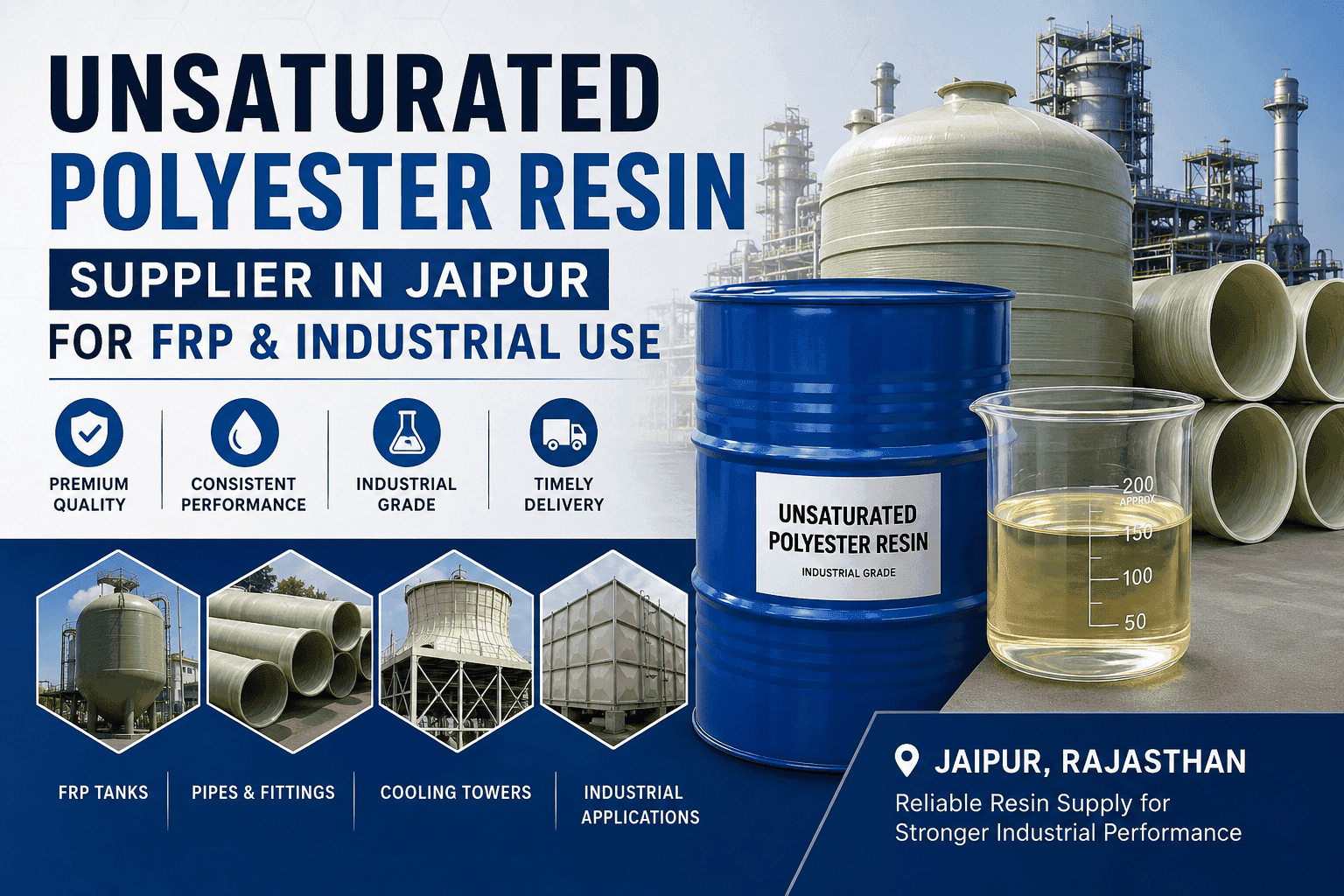
Industrial polyester resin Jaipur manufacturers commonly use is a thermosetting resin designed for producing strong, lightweight, and corrosion-resistant FRP components. In industrial fabrication, this resin acts as the binding matrix that holds glass fiber reinforcement together, creating rigid composite structures capable of handling mechanical load, moisture exposure, and chemical contact.
Unsaturated polyester resin is typically formulated using polyester polymer chains dissolved in reactive monomers such as styrene. Once mixed with catalyst and accelerator systems, the material undergoes cross-linking and hardens into a durable composite structure. Unlike conventional plastic materials, the cured resin does not soften again under heat, which is why it is widely used in permanent industrial applications.
In FRP manufacturing, resin selection directly affects laminate strength, chemical resistance, curing behavior, and surface finish quality. Factories producing chemical storage tanks, cooling tower parts, FRP pipes, cable trays, ducts, and industrial panels generally select different resin grades based on operating conditions. For example, equipment exposed to acidic fumes or continuous water contact requires resin systems with higher corrosion resistance and dimensional stability.
Polyester resin is preferred in many industrial environments because it offers a balance between mechanical performance, processing ease, and production efficiency. Compared to some higher-cost specialty resins, it allows manufacturers to maintain economical production for medium- and large-scale FRP fabrication without compromising structural reliability in standard operating conditions.
In Rajasthan-based fabrication units, especially across industrial zones such as Sitapura and VKI Jaipur, FRP resin is widely used in hand lay-up, spray-up, pultrusion, and molding processes. Production teams often prefer these resin systems because they provide controlled curing, good fiber wetting, and compatibility with commonly used glass fiber materials.
For FRP tank manufacturing, improper resin selection can result in surface cracking, osmotic blistering, or chemical attack over time. In pipe manufacturing applications, low-grade resin systems may lead to premature structural weakening under pressure and temperature variation. Because of this, manufacturers typically match resin grades according to application-specific exposure conditions rather than using a single resin across all products.
Thermosetting resin systems are also widely adopted because they support high-volume industrial production with relatively faster processing cycles. This becomes important for FRP component manufacturers handling continuous production schedules where curing time directly impacts operational throughput and mold utilization.
In practical industrial use, resin quality consistency is as important as the fiberglass reinforcement itself. Even minor variation in viscosity, curing characteristics, or styrene balance can affect fabrication efficiency and final product performance in large-scale FRP manufacturing environments across Jaipur and Rajasthan.
Selecting the correct resin grade is critical in FRP production because different industrial environments demand different levels of corrosion resistance, mechanical strength, and thermal stability. In many FRP manufacturing units across Jaipur and Rajasthan, resin selection directly affects product life, maintenance frequency, and structural reliability.
For standard FRP fabrication work, orthophthalic-based GP resin is commonly used due to its balanced processing characteristics and cost-effective performance. It is widely preferred in general-purpose FRP applications such as molded products, cable trays, decorative panels, ducts, and low to medium chemical exposure components. Manufacturers using hand lay-up or spray-up processes often prefer laminating resin grades because of their good wetting properties and easier glass fiber bonding during fabrication.
In FRP molding operations, production teams usually select resin grades based on curing behavior and surface finish requirements. FRP molding resin with controlled viscosity helps reduce air entrapment during lamination, which becomes important in products requiring dimensional consistency and smoother finishing. Poor resin selection in such applications can lead to surface cracks, weak bonding, or premature delamination under continuous load conditions.
For more demanding industrial environments, isophthalic resin is generally preferred over standard GP grades. ISO resin offers better chemical resistance, improved water resistance, and higher durability in aggressive operating conditions. This becomes particularly important in chemical processing industries where FRP tanks, scrubbers, pipelines, and reaction vessels are exposed to acids, alkalis, or moisture for long operational cycles.
In FRP tank manufacturing, using standard GP grades in high-corrosion environments often increases the risk of blistering and internal surface degradation within a short period. Many fabrication units handling chemical storage applications therefore shift toward isophthalic resin systems for better long-term reliability. This is especially relevant for industries operating in RIICO industrial zones and process plants where equipment failure can result in production stoppages and expensive repair work.
Another important factor is manufacturing method compatibility. Laminating resin grades are generally selected for manual fabrication processes because they provide better fiber impregnation and workable gel times. On the other hand, certain automated FRP production lines require resin systems with controlled reactivity and faster curing cycles to maintain production efficiency.
In cooling tower components and industrial ducts, resin performance under continuous moisture exposure becomes a major selection criterion. Orthophthalic grades may work adequately for non-critical sections, but ISO-based systems are usually preferred where structural durability and water resistance are priorities. Experienced FRP manufacturers often evaluate not only initial fabrication ease but also long-term maintenance impact before finalizing resin grades.
Industrial buyers also consider consistency in resin batches during procurement. Variations in viscosity, curing speed, or filler compatibility can affect production quality across multiple manufacturing cycles. This is why technical evaluation becomes important before selecting material for large-scale FRP production.
This material selection process also plays an important role when choosing resin systems for FRP lining applications and chemical-resistant industrial structures.
Need help selecting the right resin grade for your manufacturing process? Working with technically experienced suppliers can help avoid material mismatch and long-term production issues.
In FRP manufacturing, resin selection directly affects structural strength, corrosion resistance, curing stability, and long-term maintenance performance. Different industrial products require different resin behavior under heat, chemicals, vibration, moisture, and outdoor exposure. This is why choosing the correct material grade becomes critical during fabrication planning.
For manufacturers involved in tanks, piping systems, cooling equipment, and molded industrial components, working with the right Resin Supplier for FRP Manufacturing helps ensure process consistency and reduced production rejection.
FRP chemical storage tanks are among the most demanding applications for polyester-based systems. Tanks used in acid handling, water treatment plants, electroplating units, and chemical processing facilities require resin systems capable of resisting chemical attack for extended periods. In many industrial environments, low-grade or improperly cured resin leads to internal surface blistering, softening, or micro-cracks within months of operation.
For example, in hydrochloric acid or caustic chemical storage applications, resin compatibility becomes more important than simply increasing laminate thickness. Many FRP tank fabricators across Rajasthan prefer corrosion-resistant laminating systems with stable curing characteristics to avoid premature lining failure and leakage issues.
In outdoor tank installations, UV exposure also becomes a concern. Resin systems with poor weather resistance often develop surface chalking and fiber exposure, especially in high-temperature regions like Jaipur and nearby industrial belts. Proper resin formulation helps maintain structural stability and reduces maintenance shutdowns.
FRP piping systems also place heavy performance demands on resin quality. Pipes used for chemical transfer, wastewater movement, scrubber lines, and industrial drainage systems operate under continuous pressure and chemical exposure. In such systems, improper resin selection may result in delamination around joints, internal erosion, or brittle cracking during pressure fluctuations.
For FRP pipe manufacturing, viscosity consistency and bonding strength are critical during filament winding and hand lay-up operations. Resin systems with unstable curing cycles can create weak laminate bonding, affecting hydrostatic pressure performance. This becomes especially problematic in underground chemical pipelines where repair access is difficult and downtime costs are high.
Many manufacturers producing large-diameter FRP pipes for process industries prefer controlled-reactivity resin systems to achieve uniform curing across the entire laminate thickness. This helps avoid internal stress formation during production.
Cooling tower manufacturing is another major industrial application where resin performance directly affects service life. Cooling towers continuously face moisture, heat variation, UV exposure, and chemical-laden water circulation. In these operating conditions, inferior resin grades often lead to surface erosion, fiber bloom, and gradual weakening of structural sections.
The demand for specialized cooling tower resin is especially high in industrial regions where power plants, process industries, and HVAC infrastructure operate continuously. Resin used in fan stacks, louvers, casing panels, and structural supports must maintain dimensional stability even under fluctuating environmental conditions.
One common field issue observed in cooling tower structures is laminate weakening near fastener joints due to poor resin wet-out during fabrication. Over time, vibration and moisture penetration accelerate crack formation around stressed areas. Proper resin flow characteristics during molding help reduce such failures significantly.
Automotive and transportation components also utilize polyester-based FRP systems in applications where lightweight strength and shape flexibility are important. Molded FRP parts such as vehicle panels, battery covers, roof sections, cable trays, and protective enclosures require resin systems capable of maintaining dimensional accuracy during repetitive molding cycles.
In these applications, curing speed control becomes essential for production efficiency. Excessive shrinkage during curing can distort molded parts, affecting assembly alignment and surface finish quality. Manufacturers often select resin systems based on mold release performance, mechanical strength, and post-curing stability.
For industrial fabrication units producing custom molded parts, resin consistency directly impacts rejection rates. Even slight variation in gel time or catalyst response can disrupt production planning during bulk manufacturing.
Industrial panels and structural FRP sections are another growing application area. FRP panels are widely used in chemical plants, clean rooms, electrical insulation systems, factory partitions, and corrosive processing environments. These panels require balanced mechanical strength and chemical resistance while maintaining lightweight properties.
In high-humidity industrial zones, poor-quality resin systems may absorb moisture over time, leading to reduced rigidity and surface deformation. This is particularly important in applications involving electrical insulation or process-area wall cladding where structural reliability matters.
For molded FRP products used in industrial environments, resin compatibility with fillers, reinforcements, and additives also affects final product quality. Uneven curing or poor bonding with fiberglass reinforcement can create internal voids that weaken the final structure under mechanical stress.
Across FRP manufacturing operations, one of the most overlooked factors is long-term thermal cycling performance. Equipment exposed to alternating heat and cooling conditions experiences continuous expansion and contraction. Resin systems lacking proper flexibility characteristics may eventually develop stress cracks near joints and corners.
This becomes especially critical in process industries operating around the clock, where unexpected FRP component failure can interrupt production lines and increase maintenance costs. In many fabrication projects, the actual issue is not laminate thickness but incorrect resin selection for the operating environment.
Manufacturers involved in FRP tanks, pipelines, cooling systems, and industrial structures often evaluate resin systems based on:
This application-based selection approach helps improve product life while reducing repair frequency and operational downtime in industrial environments across Jaipur and Rajasthan.
Choosing resin according to actual operating conditions rather than only cost considerations becomes essential in large-scale FRP manufacturing applications.
In FRP manufacturing, the performance of the final product often depends more on resin consistency than on reinforcement thickness. Many factories in Jaipur and Rajasthan face recurring failures not because of fabrication errors, but because of inconsistent or low-grade resin batches entering production.
When selecting <b>Resin for Industrial Use Jaipur</b>, buyers usually focus on price per kilogram. However, production teams often end up paying a much higher hidden cost through rejected components, shutdowns, and repeated maintenance work.
One of the most common issues caused by poor quality resin is surface cracking in FRP products exposed to vibration, temperature variation, or chemical environments. In applications such as chemical storage tanks, scrubbers, ducts, and cooling tower components, weak resin performance can lead to visible cracks within a short operational cycle. Once cracking begins, moisture and chemicals start penetrating the laminate structure, reducing overall equipment life.
Delamination is another major industrial failure scenario. In FRP tank fabrication and pipe manufacturing, weak resin bonding between fiberglass layers can cause separation under load or pressure. This is especially risky in industries handling corrosive chemicals where FRP structures are continuously exposed to acidic or alkaline environments. Even minor bonding inconsistencies can result in layer peeling, structural weakness, and leakage during operation.
Factories using poor quality laminating resin also experience curing inconsistency during production. In practical manufacturing conditions, this leads to uneven hardness, sticky surfaces, improper finishing, and dimensional instability. For production units supplying FRP products to industrial clients, rejected dispatches become a serious operational issue. A single rejected tank or molded component can delay multiple deliveries and disrupt the production schedule for several days.
Leakage failures are particularly costly in industrial environments. In FRP chemical tanks or process pipelines, inferior resin quality can reduce corrosion resistance significantly. Over time, this creates pinholes, seepage points, and internal laminate degradation. The repair cost is not limited to the FRP component itself. Factories may also face chemical handling risk, plant shutdowns, labor loss, and customer penalties.
Industrial buyers in RIICO and VKI industrial areas often prioritize quick procurement during urgent production requirements. But in many cases, sourcing resin only based on immediate availability creates long-term reliability problems. Resin batches with inconsistent viscosity or poor curing behavior can affect spray-up, hand lay-up, and filament winding processes directly. Production teams then spend additional hours correcting finishing defects, reworking laminates, or scrapping partially manufactured products.
Another major issue seen in FRP manufacturing is variation between resin batches. Inconsistent raw material sourcing can create color variation, curing instability, and unpredictable mechanical strength. For industries manufacturing standardized FRP products at scale, such inconsistency affects quality control and client approvals. This becomes a bigger concern when supplying to sectors like water treatment, chemical processing, or infrastructure projects where performance expectations are strict.
In several industrial cases across Rajasthan, manufacturers shifted suppliers only after facing repeated complaints regarding brittle laminates, premature failures, or excessive repair frequency. Procurement savings achieved through cheaper resin sourcing were later offset by downtime losses, replacement expenses, and damaged client trust.
Using inconsistent resin quality can increase maintenance and production losses, especially in continuous manufacturing environments where delivery timelines are critical. For this reason, experienced procurement teams usually evaluate not just pricing, but also supply consistency, technical reliability, and application suitability before finalizing industrial resin suppliers.
This becomes even more important for manufacturers sourcing materials for high-load FRP applications or corrosion-resistant equipment where long operational life is expected.
For procurement teams sourcing from a Jaipur-based <b>FRP Raw Material Supplier Jaipur</b>, technical consistency matters far more than basic pricing. In FRP manufacturing, even small variations in resin specifications can affect laminate strength, curing behavior, surface finish, and long-term durability. Many production issues in Rajasthan-based fabrication units are not caused by machine problems, but by inconsistent resin batches supplied without proper technical validation.
One of the first parameters buyers should evaluate is resin viscosity. Resin with incorrect viscosity creates handling issues during processing and can directly impact fiber wet-out quality. Low-viscosity material may lead to excessive resin flow and uneven laminate thickness, while overly thick resin can trap air pockets and create dry fiber zones. In several fabrication environments near Sitapura and VKI industrial areas, inconsistent viscosity has resulted in roller marks, weak bonding layers, and additional rework during production cycles.
Curing properties are equally critical during procurement evaluation. Resin that cures too quickly can reduce working time and increase material wastage, especially during large batch processing. On the other hand, delayed curing often creates operational bottlenecks where moulds remain occupied longer than planned, reducing production throughput. Industrial buyers should always verify gel time consistency, catalyst compatibility, and ambient temperature behavior before approving bulk purchases.
A common issue seen in industrial procurement is resin mismatch with existing manufacturing systems. Compatibility testing becomes essential when factories use specific fillers, fiberglass mats, accelerators, or pigment systems. Even technically acceptable material can create separation issues or incomplete curing if compatibility is ignored. Procurement teams should request technical data validation instead of relying only on generic product naming such as GP resin or laminating resin.
Storage conditions also play a major role in maintaining resin quality after delivery. Improper storage exposure during Rajasthan summers can significantly reduce shelf stability. Heat-sensitive resin stored without controlled handling may show premature thickening, inconsistent curing response, or reduced bonding performance. Buyers should confirm recommended storage temperatures, shelf life, packaging quality, and transportation practices before finalizing supply contracts.
Another overlooked factor is batch-to-batch consistency. Many factories face production interruptions because the supplied material behaves differently in subsequent lots. Variations in curing behavior or viscosity often force machine recalibration and process adjustment, increasing downtime risk. Experienced procurement managers therefore prioritize suppliers who maintain stable sourcing channels and documented quality checks rather than selecting material solely on short-term pricing advantage.
Mechanical strength validation is also important during incoming material inspection. Resin specifications should align with the required tensile strength, adhesion performance, and structural reliability expected by the manufacturing setup. Inconsistent raw material quality can eventually increase rejection rates, laminate cracking, and repair costs during downstream production.
Industrial buyers in Rajasthan increasingly prefer suppliers who can provide technical clarity along with supply availability. Reliable sourcing support becomes especially important when production schedules are tight and replacement procurement delays can affect dispatch commitments. Working with an experienced supplier network helps reduce uncertainty during bulk industrial procurement and improves long-term process stability.
Selecting the right Shri Ganesh Sales or any reliable Polyester Resin Dealer Jaipur is not only about price comparison. In FRP manufacturing and industrial fabrication, procurement consistency directly affects production timelines, laminate quality, and delivery commitments to end customers.
In many FRP units across Sitapura, VKI Jaipur, and RIICO industrial areas, production delays often happen because resin shipments arrive late, material grades vary between batches, or suppliers fail to maintain stock during urgent requirements. For industries manufacturing chemical tanks, cooling towers, ducts, pipes, or molded FRP components, even a one-day supply interruption can stop lamination work completely.
One of the first factors industrial buyers should evaluate is stock availability. A supplier working only on order-based procurement may struggle during sudden demand spikes or raw material shortages. On the other hand, experienced industrial suppliers usually maintain ready inventory of commonly used laminating resin, GP resin, and FRP raw materials for recurring industrial consumption. This becomes critical when factories need urgent replenishment to avoid machine idle time or production backlog.
Delivery capability is equally important. Many procurement teams focus only on quotation value and overlook logistics reliability. In Rajasthan, especially for industrial zones around Jaipur, Bhiwadi, Kota, and Udaipur, fast dispatch support can significantly reduce operational downtime. A dependable resin distributor should have a sourcing and transport network capable of handling bulk movement without repeated follow-ups from the buyer side.
Bulk supply support is another major evaluation parameter. Several FRP manufacturers increase production seasonally based on infrastructure projects, water treatment demand, or industrial expansion work. During these periods, suppliers with weak inventory planning often fail to fulfill large-volume orders consistently. Industrial buyers should verify whether the supplier can handle recurring bulk dispatches without compromising material availability.
Technical support also plays a practical role during procurement decisions. Even when buyers already know the required material grade, manufacturing conditions may change depending on application type, curing environment, or end-use exposure. Experienced FRP suppliers often help buyers identify whether the existing resin system is suitable for high-corrosion environments, outdoor exposure, tank fabrication, or structural FRP work. This type of practical guidance becomes valuable during production troubleshooting or when shifting to new applications.
Another important factor is sourcing strength. In industrial procurement, hard-to-find materials become a major issue during market shortages or sudden project demand. Resin stockists with broader sourcing networks are usually better positioned to arrange urgent industrial materials quickly. This reduces dependency on multiple vendors and simplifies procurement management for factory purchase teams.
Industrial buyers should also evaluate supplier responsiveness. Delayed communication during urgent requirements often leads to extended production stoppage. Reliable industrial suppliers usually maintain faster coordination for quotation sharing, dispatch updates, and material confirmation, helping procurement teams plan operations more efficiently.
For buyers handling long-term FRP manufacturing operations, working with a supplier that understands industrial production cycles is more beneficial than purchasing purely on short-term pricing. Low-cost sourcing without supply consistency often results in repeated procurement disruptions, delayed deliveries to clients, and additional operational pressure on production teams.
This becomes especially important for industries connected with chemical processing, water treatment equipment, cooling tower manufacturing, FRP lining, and industrial fabrication work across Rajasthan, where uninterrupted material availability directly impacts project execution timelines.
For industrial buyers looking for reliable sourcing support, suppliers like Shri Ganesh Sales help industries manage bulk resin procurement with faster material arrangement, wider sourcing capability, and industrial supply support across Jaipur and Rajasthan.
Discuss your industrial resin requirement with our Jaipur supply team for bulk availability, sourcing assistance, and fast industrial dispatch support.
In FRP manufacturing and industrial fabrication, procurement delays often create bigger operational problems than material cost itself. A delayed resin shipment can stop tank lamination work, postpone pipe production schedules, or interrupt dispatch commitments for fabricated FRP components. This is one of the main reasons many industries prefer working with a local Shri Ganesh Sales or other established Jaipur-based sourcing partners instead of depending entirely on out-of-state supply chains.
For industries operating in Sitapura, VKI, RIICO zones, Bhiwadi, Kota, and nearby industrial belts, working with an experienced local resin supplier offers a practical operational advantage. Urgent material requirements are common in FRP manufacturing environments, especially when production batches increase unexpectedly or raw material consumption rises due to rework, large tank orders, or continuous lamination cycles. In such situations, faster coordination and immediate material dispatch become critical.
A reliable Industrial Resin Supplier Rajasthan manufacturers trust can help reduce downtime caused by delayed procurement. This becomes especially important for industries handling:
In many factories, production teams cannot afford to wait several days for interstate transportation when resin inventory runs low unexpectedly. Local sourcing helps reduce dependency on long logistics routes, transport uncertainties, and dispatch bottlenecks that frequently affect industrial procurement timelines.
Another major advantage of working with a Rajasthan resin supplier is easier technical coordination. Procurement teams often need quick confirmation regarding availability, compatible grades, batch continuity, or urgent replenishment planning. Coordinating with a nearby supplier simplifies communication and speeds up decision-making during active production cycles.
For example, during FRP chemical tank fabrication, sudden increases in resin consumption are common when additional reinforcement layers are required due to design changes or chemical resistance specifications. In such cases, delayed material availability can directly impact project completion timelines and labor productivity. Local suppliers are generally in a better position to respond quickly to these urgent requirements.
Industries also prefer local sourcing because transportation handling becomes more manageable. Long-distance resin transportation can sometimes lead to delayed unloading schedules, handling damage risks, or supply inconsistency during peak logistics periods. A Jaipur industrial supplier with regional delivery capability can often support faster replenishment across Rajasthan industrial zones with better dispatch visibility.
This procurement reliability becomes even more valuable for manufacturers handling continuous production schedules. In FRP processing, stopping lamination work midway due to material shortage can lead to manpower idle time, delayed curing cycles, and production inefficiencies. Many experienced factory managers prioritize supplier responsiveness over marginal price differences because operational downtime usually costs significantly more than procurement savings.
For industrial buyers looking for dependable FRP raw material supplier Rajasthan support, supplier network strength also matters. Access to bulk material movement, sourcing capability for urgent requirements, and consistent stock handling all play a major role in maintaining uninterrupted manufacturing operations.
Experienced suppliers such as Shri Ganesh Sales help industries across Jaipur and Rajasthan manage urgent procurement requirements through faster coordination, regional supply capability, and access to commonly required industrial materials. This is particularly useful for manufacturers working on time-sensitive FRP fabrication projects where production continuity is critical.
Fast industrial resin delivery available across Jaipur and Rajasthan for FRP manufacturing, fabrication units, and industrial production requirements.
For FRP manufacturers, fabricators, and industrial production units, working with a reliable Shri Ganesh Sales is not just about material availability — it directly affects production continuity, delivery timelines, and product quality. In applications such as FRP chemical tanks, cooling towers, industrial ducts, and pipe manufacturing, inconsistent resin supply or incorrect resin grade selection can lead to bonding failures, reduced corrosion resistance, and costly rework during fabrication.
Choosing an experienced FRP Resin Supplier Jaipur industries can depend on becomes especially important when handling bulk manufacturing requirements across RIICO areas, Sitapura, VKI, and other industrial zones in Rajasthan. Industrial buyers typically require consistent viscosity, reliable curing performance, proper packing, and uninterrupted supply support for large-scale production cycles. Delays in procurement often result in machine idle time, manpower loss, and missed dispatch schedules.
A dependable industrial resin supplier also helps manufacturers source suitable material grades based on application requirements such as laminating, hand lay-up, pultrusion, or corrosion-resistant FRP systems. This becomes critical in sectors handling chemicals, water treatment systems, fabrication projects, and industrial maintenance operations where resin performance directly impacts service life.
For industries looking for a Rajasthan resin supplier with strong sourcing capability and fast dispatch support, suppliers with established industrial networks can significantly reduce procurement risk and emergency downtime. This is particularly useful for factories managing urgent bulk requirements or ongoing FRP production operations across Jaipur and nearby industrial regions.
Contact Shri Ganesh Sales today for bulk industrial resin supply across Jaipur and Rajasthan, including support for FRP manufacturing, tank fabrication, industrial lining, and heavy-duty composite applications.